
Diagnostic Informatics is expanding what can be done with diagnostic information, while laboratories and healthcare systems remain under persistent financial and human-resource constraints. The strategic question for Diagnostics is where digital capability can improve diagnostic services in ways that are distinctive, scalable and economically credible. The argument can be summarised in three questions: which applications should remain independent or become part of the diagnostic product, how responsibility changes with the architecture, and which actors have lasting reasons to participate.
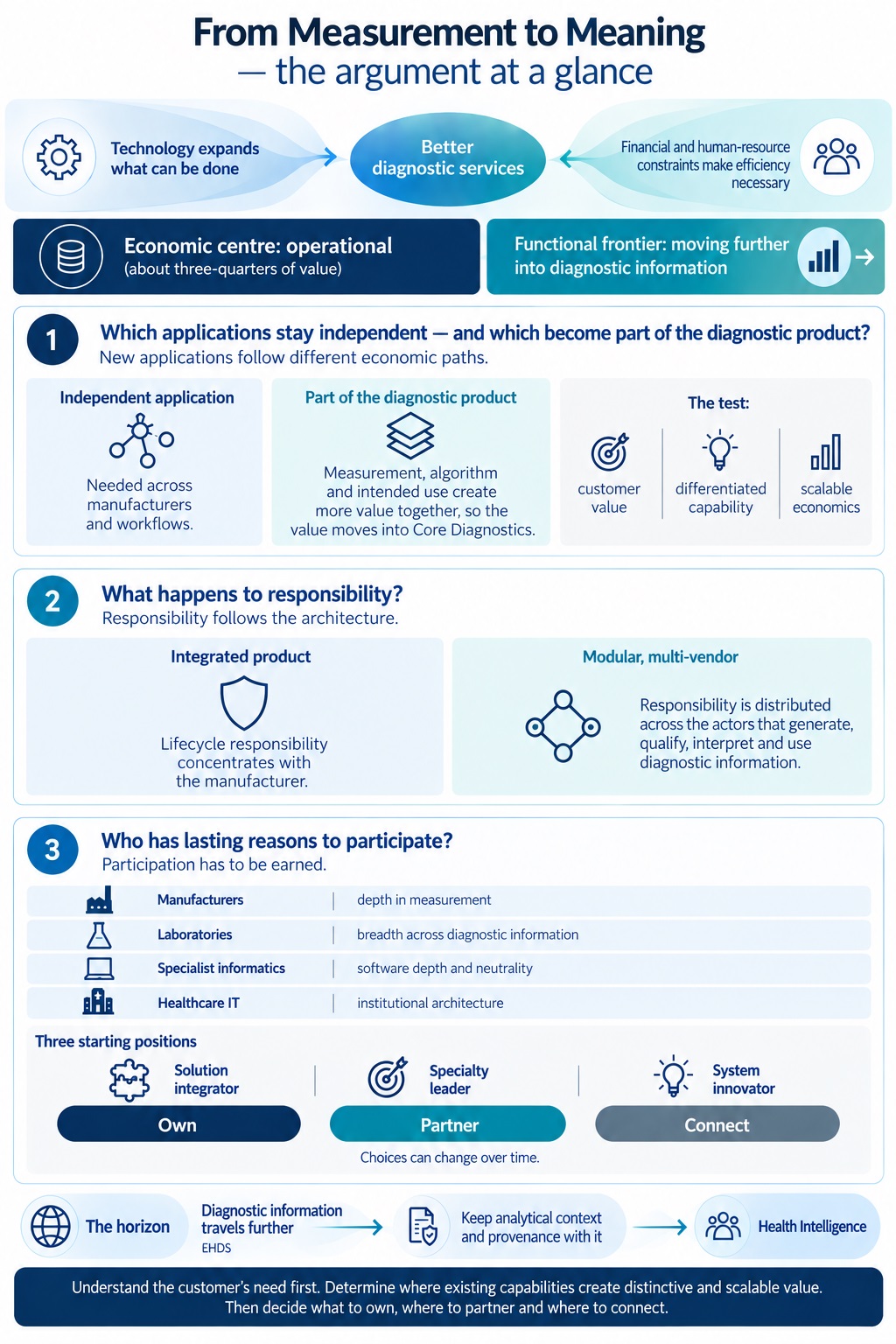
Six inferences
Persodia’s inferences from the evidence: propositions to test as the market develops.
1. Backbone or applications. Platforms reward breadth, installed base and integration. Applications reward depth in one diagnostic problem. Some companies will do both; few will be equally strong at both.
2. Openness is the real test. Standards could let smaller companies plug their applications into larger backbones. Diagnostics grew up on closed, validated systems. Keeping that discipline in an open environment decides how far ecosystems can go.
3. Close to the measurement, close to IVD. The tighter the coupling of measurement, computation and intended use, the stronger the manufacturer’s claim.
4. Reliability is king. Computational outputs will be adopted as far as their reliability can be shown, monitored and governed. Diagnostics already does this for analytical systems.
5. Responsibility gates adoption. Laboratories need to know who answers for each step in the chain. Functionality comes second.
6. Use case by use case. Holistic solutions get the attention. Adoption will move through defined clinical questions on common infrastructure, longitudinal analysis included.
The sections that follow set out the evidence behind the figure and these six inferences: how the economic centre and the functional frontier are evolving, where digital capability strengthens the diagnostic proposition, what Diagnostics and the other actors each bring, where the laboratory stands and who carries responsibility, and how companies can decide what to own, where to partner and where to connect.
Diagnostic Informatics and the changing value of diagnostic information
The accompanying Persodia Observation described a Diagnostic Informatics market whose economic centre remains firmly operational. About three-quarters of the value identified supports laboratory operations, about a fifth sits in applications working more directly on diagnostic information, and a smaller share extends its use further.
It also left three questions open. Which newer applications will develop as independent markets and which will become part of diagnostic products? What happens to diagnostic responsibility as information travels beyond the analytical process? And where do manufacturers, laboratories, specialist informatics companies and healthcare IT providers have lasting reasons to participate?
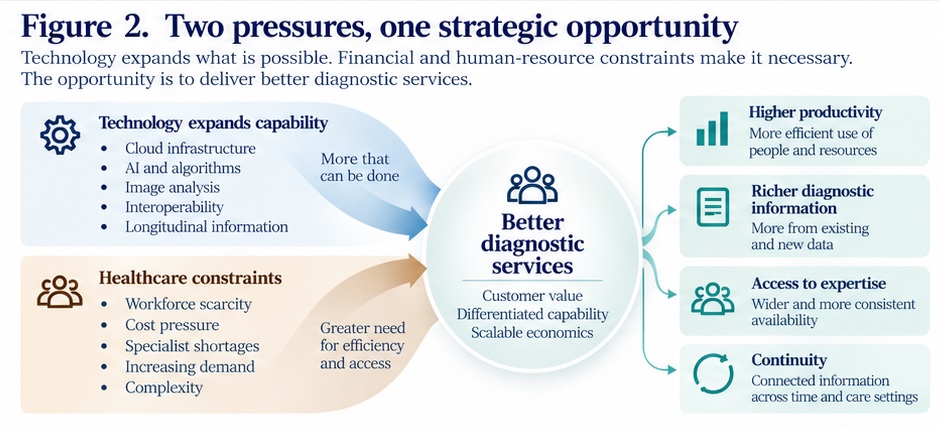
Two forces make these questions increasingly important.
Technology is expanding what can be done with diagnostic information. Cloud infrastructure, AI, advanced algorithms, image analysis, improved interoperability and increasingly capable computational methods allow diagnostic information to be integrated, analysed, interpreted and used in ways that were previously difficult or impossible.
At the same time, laboratories and healthcare systems operate under persistent financial and human-resource constraints. They need greater productivity, access to scarce expertise, better integration and manageable complexity while maintaining quality and responding to increasing diagnostic demand.
Diagnostic Informatics sits at the intersection. It can help deliver diagnostic services more efficiently and make those services better: extracting more information from measurements, supporting interpretation, connecting information across time and making expertise more widely available.
For the Diagnostics industry, the strategic question is where it can help customers most effectively, distinctively and economically—building on capabilities it already possesses while recognising where laboratories, specialist software companies and healthcare IT providers are better positioned.
1. The economic centre remains operational. The functional frontier is moving.
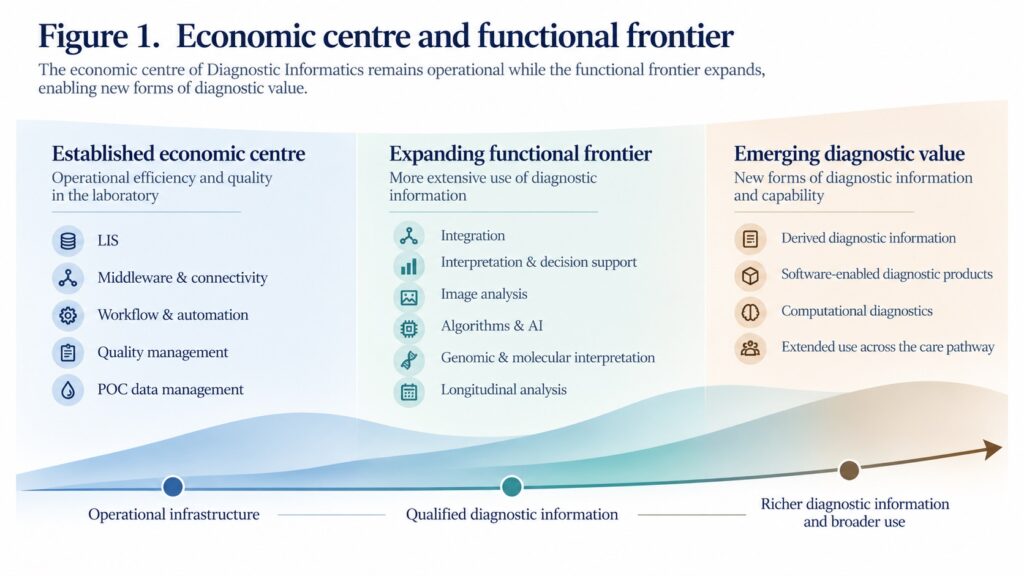
LIS, middleware, connectivity, workflow, quality management and point-of-care data management form much of the economic centre of Diagnostic Informatics. They allow laboratories to process increasing workloads, automate processes, maintain quality and connect complex diagnostic environments. Persistent resource constraints reinforce their importance.
The functional frontier is expanding around them. AI-assisted image interpretation, diagnostic algorithms, genomic and molecular interpretation, advanced morphology, automated interpretation, precision dosing and pharmacogenomics, longitudinal diagnostic analysis and emerging patient-facing applications operate further into diagnostic information than traditional laboratory IT.
The direction can already be seen in different forms.
EUROIMMUN’s EUROLabOffice 4.0 illustrates how specialist Diagnostics companies can extend from laboratory operations towards richer use of diagnostic information. EUROLabOffice connects the LIS with EUROIMMUN workstations and automation, manages laboratory workflow and patient information, and provides functionality supporting interpretation. The significance is the progression from managing the analytical process towards making diagnostic information easier to consolidate, contextualise and interpret.
Other applications move further into interpretation and clinical decision support. Digital pathology provides a particularly visible example of another model. Leica Biosystems’ Aperio AI Store, available within Aperio HALO AP, provides access to AI tools from multiple specialist partners through a common interface. Leica explicitly positions the model around embedding specialised applications within an existing pathology environment rather than requiring laboratories to operate separate interfaces for each algorithm.
These developments expose a customer problem. Each additional application can bring another interface, security model, implementation project, validation requirement and maintenance process. As specialised applications multiply, laboratories cannot indefinitely absorb equivalent growth in integration burden.
The resulting architectural pressure is towards common infrastructure capable of supporting increasingly diverse applications:
Scalable infrastructure → qualified diagnostic information → modular applications
Infrastructure can consolidate connectivity, identity, security, data models and workflow. Applications can remain specialised because diagnostic needs differ by specialty, disease, institution and clinical question.
Roche’s navify Algorithm Suite provides a useful example. It hosts Roche and partner algorithms and connects them with existing LIS and EMR environments, separating common infrastructure and integration from the individual algorithm products themselves.
The objective is to make better diagnostic capabilities deployable without allowing the customer’s operational burden to grow at the same rate.
2. Better diagnostic services under constrained resources
Emerging technology becomes strategically relevant when it improves the diagnostic service.
An application that reduces manual review can increase productivity. An interpretation tool can make scarce specialist expertise available across several sites. Longitudinal analysis can derive additional information from measurements already performed. Computational methods can make complex diagnostic knowledge available more consistently. Cloud deployment can extend access to applications and expertise while changing how software is maintained and updated.
The strongest opportunities can address both forces simultaneously: improving diagnostic capability while making better use of constrained resources.
Technology alone, however, does not create an attractive business.
A sophisticated application can produce genuine clinical or operational value while remaining commercially unattractive if each implementation requires extensive customisation, bespoke interfaces, repeated validation and continuing local support. A comparatively modest application can create considerable economic value when it strengthens an existing diagnostic proposition, increases utilisation, improves retention or makes a broader solution more competitive.
The strategic opportunity sits where customer value, differentiated capability and scalable economics intersect.
This has an important consequence. The question is not only whether software creates value, but where that value should reside.
3. Some informatics opportunities will become Diagnostics
Some software will remain identifiable applications because customers need it across products, manufacturers and workflows.
Other capabilities will increasingly become components of the diagnostic product itself. Measurement, analytical context and computation can be developed and validated together for a defined diagnostic purpose. In computational diagnostics, computation may itself become central to creating diagnostic information.
Once this happens, economic classification also changes.
Software integrated into an IVD proposition can move out of the Diagnostic Informatics perimeter and into Core Diagnostics. Its contribution may appear through product differentiation, clinical utility, utilisation, customer retention, margin or tender competitiveness rather than separately reported software revenue.
One of the most important opportunities created by Diagnostic Informatics may therefore ultimately disappear from the Diagnostic Informatics market.
A useful strategic criterion follows:
Applications needed across manufacturers and workflows have reasons to remain independent. Capabilities whose measurement, algorithm and intended use create more value together have reasons to become part of the diagnostic product.
This is particularly important under resource constraints. Integration into the product can reduce implementation and validation burden where the manufacturer has a genuine reason to control the complete proposition. Cross-vendor applications have different economics and often require neutrality, making independent or partnered models more credible.
For a Diagnostics company, the relevant question becomes: where should software and computation sit in the customer proposition?
4. What Diagnostics brings to the frontier
Diagnostics manufacturers bring distinctive capabilities to this question.
They understand their measurements, analytical limitations, calibration, quality, validation and product lifecycle. They have experience converting complex science into reproducible products that can operate across large numbers of institutions.
Computational products extend that industrial problem.
A conventional analytical system operates under defined specifications with controlled changes to assays, reagents, instruments and software. Computational performance can also be affected by changes in data distributions, patient populations, reference information, connected systems and models. The software can continue to operate as designed while the environment relevant to its performance has changed.
Industrialising computational diagnostics therefore requires continuous attention to data curation, provenance, version control, cybersecurity, performance monitoring and controlled change.
As more diagnostic value is created computationally, data quality becomes part of diagnostic quality.
Other actors bring different strengths. Specialist informatics companies can offer software depth, development speed and cross-vendor capability. Healthcare IT providers control important institutional architecture, identity and clinical workflow. Laboratories possess professional diagnostic expertise and information generated across multiple technologies, suppliers and specialties over time.
A manufacturer can have unmatched depth in its own measurement. A laboratory can have unmatched breadth across diagnostic information. A software or healthcare IT company may be better positioned to provide neutral infrastructure connecting both.
The opportunity for Diagnostics therefore depends on where its combination of analytical knowledge, validation discipline and industrial scale creates better customer value.
5. The laboratory has a distinctive position
The laboratory occupies a distinctive position because it sits across technologies rather than inside a single manufacturer’s portfolio.
It operates and validates diagnostic processes, maintains quality, interprets information and connects technologies from multiple manufacturers. It can also hold diagnostic information across specialties and over time.
That creates a form of strategic advantage different from manufacturer expertise. Manufacturers can possess exceptional depth around proprietary measurements and analytical systems. Laboratories can possess breadth across measurements, methods, manufacturers and the patient’s diagnostic history.
The distinction becomes more important as value moves towards integration, interpretation and longitudinal use.
Laboratories can be customers for these capabilities, but also co-development and validation partners, information integrators and providers of digital diagnostic services. Networks can use digital capabilities to share specialist knowledge, balance workloads, centralise particular forms of interpretation or make scarce expertise available across institutions.
In selected longitudinal or multi-vendor applications, the laboratory may consequently compete from a structurally different position. Its advantage comes from the breadth of information and expertise available across the diagnostic pathway.
Responsibility also follows the architecture. When software forms part of a regulated diagnostic product, the manufacturer assumes the corresponding product and lifecycle obligations within its intended purpose. With separately supplied applications, responsibility is distributed according to intended purpose, regulatory status and implementation. Laboratories remain responsible for the quality and competence of the activities they perform, while clinical responsibility continues further into the care pathway.
As modularity increases the number of actors contributing to diagnostic information, provenance, validation, intended use and clear allocation of responsibility become increasingly important.
6. Different companies, different opportunities
There is no single digital strategy for the Diagnostics industry. Starting position matters.
Here, the three positions refer to different starting points within the Diagnostics industry: multi-department suppliers able to integrate across the laboratory, leaders with depth within a laboratory department or specialty, and focused system innovators.
Solution integrators
Large Diagnostics companies serving several laboratory departments start from the advantage of breadth.
Their opportunity is to reduce complexity across the laboratory by integrating analytical systems, automation, workflow and data-management capabilities across departments. Their broad installed base and service infrastructure can make it possible to provide a more coherent operating environment than suppliers focused on individual departments or systems.
This does not mean replacing the LIS or owning the broader healthcare information architecture. The opportunity is to simplify the Diagnostics environment while connecting effectively to LIS, hospital IT and external applications.
Solution integrators therefore need to decide which capabilities should be common across their installed base, which should remain department- or product-specific, and where interoperability or partnership creates more value than ownership.
Specialty leaders
Companies that lead within a laboratory department or major diagnostic specialty start from the advantage of depth.
They may offer several analytical systems within the same departmental environment, together with automation, workflow, middleware or data-management capabilities. Their digital opportunity therefore begins with integrating the departmental environment and can extend further into the interpretation and use of diagnostic information. It includes integrating instruments, workflows and information within the department before diagnostic information passes into the LIS or broader clinical information environment.
Digital capabilities can support instrument coordination, workflow management, quality control, consolidation of diagnostic information, specialist interpretation and other functions specific to the department or specialty.
The product-boundary decision is particularly important here. Capabilities closely linked to proprietary analytical systems, measurement characteristics and departmental workflow may create greater value inside the diagnostic proposition. Applications requiring information across departments, manufacturers or broader clinical contexts may have stronger reasons to remain independent or be provided through partnership.
Specialty leaders can therefore deepen and integrate their departmental proposition without trying to become multi-department solution integrators or enterprise IT companies.
System innovators
Smaller companies developing focused analytical systems can make architectural decisions before legacy accumulates.
Their opportunity is to make the system easy to integrate into laboratory workflows and external digital environments while preserving differentiated analytical or computational capabilities within the product itself.
Connectivity, structured diagnostic information, provenance, APIs, cybersecurity and future computational extension can be designed into the product from inception. Retrofitting them after commercial launch can require interface redevelopment, new data structures, additional validation and repeated customer-specific implementation.
Those costs consume scarce technical resources, slow implementation, lengthen customer acquisition and make growth increasingly dependent on service effort.
For a smaller company, integration readiness can therefore become part of scalability and eventually part of market access.
Figure 3 distinguishes three common starting positions for Diagnostics companies. These are not fixed company categories, but different strategic positions from which digital capabilities can be developed.
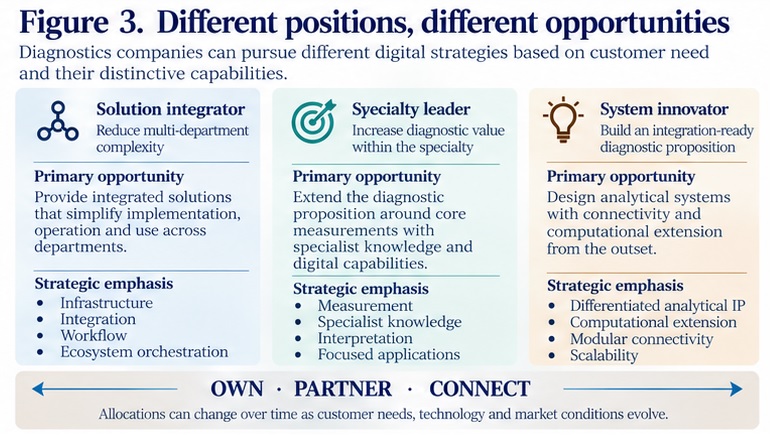
Across all three positions, the practical mechanisms are Own, Partner and Connect.
Ownership is strongest where measurement knowledge, validation, intended use and lifecycle control determine performance. Partnership can bring capabilities another organisation can provide more effectively or accelerate access to market. Connection becomes essential where customer value depends on multi-vendor information or institutional systems outside one supplier’s control.
The allocation can change. A partnered capability may justify ownership when it becomes central to differentiation, validation or recurring economics. An owned capability may need to open to other suppliers when neutrality and interoperability become more valuable to customers.
A Diagnostics company entering a consolidated tender, for example, may have an excellent analytical portfolio but lack one component of the wider solution. Partnership can close that gap faster than internal development, strengthen the overall proposition and reduce the need to compensate through price.
7. Diagnostic information is entering a wider healthcare environment
These decisions will increasingly be made within healthcare environments expecting information to travel further.
Europe provides a concrete example. The European Health Data Space is establishing a common framework for access, exchange and reuse of electronic health data, with implementation phased over the coming years.
For Diagnostics, the relevance extends beyond technical interoperability.
A laboratory measurement separated from method, provenance, analytical context, reference information or relevant interpretive conditions may remain technically exchangeable while becoming less useful for its subsequent purpose. Greater mobility of information therefore increases the importance of maintaining the structure and context that make diagnostic information meaningful.
This connects the present development to the longer evolution described in Inside the Clinical Diagnostics Industry: from the industrialisation of analytical systems through informatisation, integration and increasing specialisation towards a further phase in which diagnostic information becomes progressively more integrated, longitudinal and computationally useful.
The wider direction is Health Intelligence. Diagnostic information can increasingly contribute to broader, longitudinal understanding of health while retaining the analytical context and diagnostic discipline on which its usefulness depends.
Diagnostic Informatics is one contributor to that trajectory. Its immediate strategic relevance remains closer to home: helping Diagnostics and its customers create more value from diagnostic information while preserving the quality and context on which that value depends.
From measurement to meaning
The Observation’s three questions lead to three conclusions.
New applications will follow different economic paths. Capabilities needed across manufacturers and workflows have reasons to remain independent; those whose measurement, computation and intended use create more value together can become part of Core Diagnostics.
Responsibility follows the architecture. Product integration concentrates more lifecycle responsibility with the manufacturer. Modular and multi-vendor environments distribute responsibility across the actors generating, qualifying, interpreting and using diagnostic information.
Participation has to be earned. Diagnostics manufacturers bring measurement knowledge, validation discipline and industrial scale; laboratories bring professional expertise and multi-vendor information; specialist informatics companies bring software depth and neutrality; healthcare IT providers bring institutional architecture. Their positions will overlap, compete and combine differently across applications.
The economic centre of Diagnostic Informatics remains operational while its functional frontier expands. Technology makes better diagnostic services possible; financial and human-resource constraints make their efficient delivery increasingly necessary.
For the Diagnostics industry, the strategic task is to understand the customer’s need first, determine where its existing capabilities create distinctive and scalable value, and then decide deliberately what to own, where to partner and where to connect.
Links:
Diagnostic Informatics: the conversation is changing faster than the market
5 Signals from HLTH Europe That Reveal Diagnostics’ Next Challenge
Healthcare as Seen at HLTH Europe 2026
IVD Industry Monograph No. 4 – Beyond the Data Feed: Diagnostic Contribution in Health Intelligence