
When Innovation Became a Partnership Question
Healthcare innovation is abundant. Converting it into sustained adoption remains more difficult. That distinction became increasingly visible at health.tech global summit 2026 in Basel. Across a large and energetic gathering of startups, corporates, investors, advisors, institutional actors, and international delegations, innovation appeared in many forms: artificial intelligence, digital platforms, diagnostic tools, clinical workflows, prevention models, and new approaches to healthcare delivery.
Yet the most important signal was not the volume of innovation alone. It was the density of partnership conversations surrounding it.
The summit reinforced a structural reality: few organisations control all the resources required to move a healthcare innovation from concept to durable institutional use. Technology, clinical access, data, evidence generation, capital, regulation, market channels, implementation capability, and operational scale are usually distributed across different actors. The decisive question is therefore not only which ideas are differentiated, but which organisations can assemble the relationships required to make those ideas useful, scalable, and durable.
Publication date: 15-03-2026
Event: health.tech global summit 2026
Location: Basel, Switzerland
Event date: 3–5 March 2026
Why This Event Mattered
Approximately 5,000 participants gathered in Basel from across the healthcare ecosystem, including startups, corporates, investors, advisors, institutional actors, and international delegations. Around 150 startups presented technologies and business models, while the event floor created visible infrastructure for meetings, introductions, and follow-up discussions.
Artificial intelligence appeared in almost every area of the summit. Many speakers shared a recurring ambition: moving healthcare away from reactive sick care and towards earlier detection, prediction, and prevention.
However, the event was not only about technology. The more consequential discussion concerned the institutional path from innovation to deployment. The exhibition floor, meeting spaces, startup areas, and stages created multiple layers of interaction around funding, evidence, market access, partnerships, and implementation.
The relevant question emerged quickly: not whether healthcare innovation is active, but which innovations will successfully navigate the partnerships, capital requirements, evidence expectations, and institutional constraints required to reach patients at scale.
Questions I Was Watching
- Is artificial intelligence being treated primarily as a technical feature, or as a new layer of healthcare infrastructure?
- Which actors are likely to control the clinical interface as digital platforms become more consequential?
- Are partnership models evolving quickly enough to connect innovation with clinical access, evidence, regulation, and market channels?
- Do discussions treat scale only as an opportunity, or also as an operational and capital constraint?
- How are startups addressing the evidence and market-access requirements that determine whether proof of concept becomes sustained adoption?
Field Observations
Partnership became the organising logic
The most visible feature of health.tech 2026 was not a single technology. It was the density of partnership conversations.
Healthcare innovation increasingly depends on actors controlling different resources. Startups often bring focused innovation, speed, and technical specialisation. Corporates contribute industrial capability, infrastructure, market access, and operational experience. Hospitals provide clinical environments and real-world implementation settings. Investors supply capital while imposing selectivity. Advisors and ecosystem actors help organisations navigate the interfaces between them.
Few organisations control all these resources internally, which means that partnership is not incidental. It is structural.
The harder issue lies in the asymmetry between potential partners. Different actors enter discussions with different levels of capital, institutional authority, negotiating leverage, and tolerance for long development timelines. Those asymmetries shape which projects secure the support required to progress and which remain trapped between technical promise and institutional adoption.
AI is becoming an infrastructure question
Artificial intelligence appeared across the summit both as a product feature and as a wider platform question.
At one level, companies are applying AI to specific tasks: discovery, diagnostics, clinical workflows, remote monitoring, decision support, and operational efficiency. At another level, the discussion is becoming more structural. Who controls the data architecture? Who controls the clinical interface? How do algorithmic outputs integrate into professional workflows? Where does accountability remain when decisions increasingly depend on software?
A presentation from Hospital Clínic Barcelona made this particularly visible. The discussion suggested that healthcare institutions can no longer treat AI as a technology question alone. Large companies may control many of the platforms, while other organisations contribute specialised functional modules. Hospitals and healthcare systems must still determine how these capabilities are governed, validated, and embedded in routine practice.
The opportunity is substantial, but so is the coordination burden. Beneath many AI discussions, one question remained persistent: who will control the clinical interface?
Capital was visible, but conversion remained uncertain
Capital was present throughout the summit. Startups, venture-capital firms, private-equity participants, and advisors were highly visible, and funding conversations occurred frequently. However, the presence of capital did not remove uncertainty.
The relevant issue is not simply whether funding exists. It is whether capital aligns with the duration, evidence requirements, and implementation complexity of healthcare innovation. Many technologies operate within regulated environments. Market-access pathways remain fragmented. Proof-of-concept success does not guarantee reimbursement, procurement, or sustained adoption.
It was difficult to assess the number and value of potential transactions arising from the event because many discussions remained exploratory and most transactions were undisclosed. One structural point was nevertheless clear: capital is not merely a financing input. It is one of the conditions determining which innovations survive the path to scale.
Scale was discussed more often as opportunity than constraint
Participants discussed scale constantly, but often as a growth opportunity rather than as an operational constraint.
That distinction matters. Scale in healthcare requires more than customer acquisition. It demands evidence, implementation capability, infrastructure, regulatory maintenance, service delivery, data governance, and durable capital.
Regulatory fragmentation also remained visible across discussions. “USA-first” strategies appeared repeatedly, reflecting the perception that market-entry logic, reimbursement potential, and commercial scale may align more easily in some environments than in others.
Growth can expand opportunity, but it can also expose structural weakness.
Evidence and market access remained the conversion problem
The final recurring signal concerned value demonstration.
Healthcare systems remain fragmented. Adoption pathways differ between markets. Procurement, reimbursement, and clinical acceptance often follow separate timelines. Many startups remain at proof-of-concept or early-validation stage.
The technology may work, but the more difficult question is whether the complete evidence architecture is strong enough to support adoption. Healthcare systems increasingly require proof not only that an innovation performs technically, but that it creates measurable clinical, operational, or economic value.
This is where many promising concepts encounter friction. Innovation is not scarce. Conversion remains difficult.
Human Atmosphere and Professional Exchange
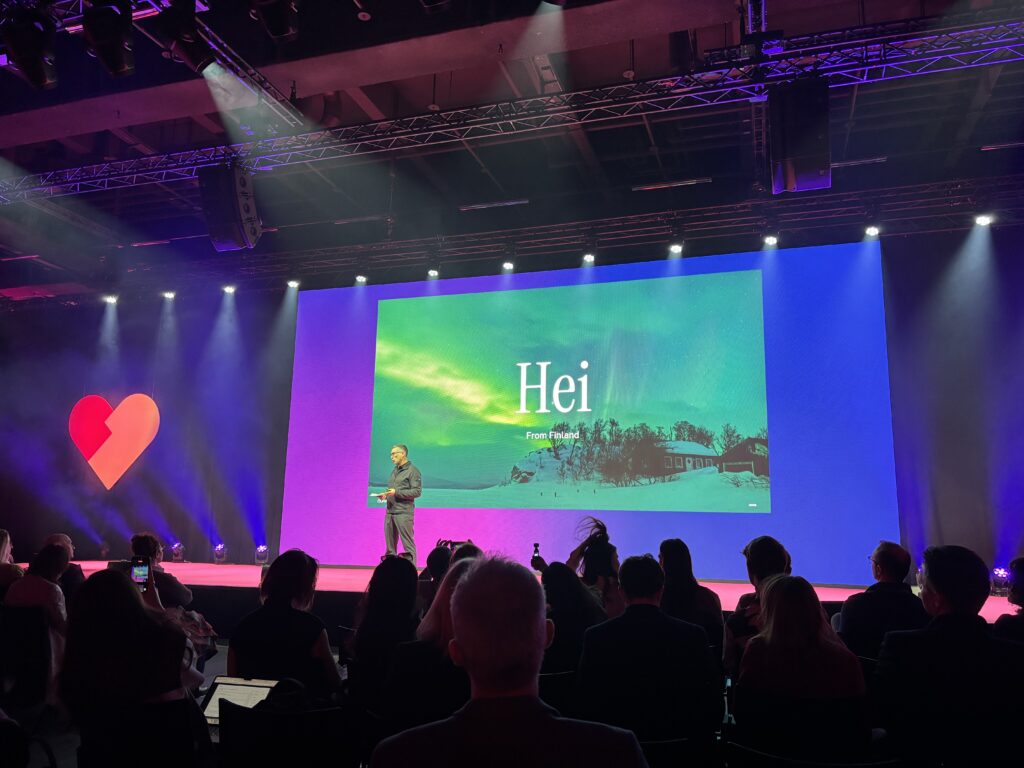
The summit had a distinctive energy. The scale was large, the staging was polished, and the exhibition floor remained active throughout the event. Yet the strongest impression was not one of spectacle alone. The visual intensity served a practical purpose: creating multiple points of contact across a fragmented ecosystem.
The formal programme created common reference points, but many of the most useful exchanges occurred outside the main sessions. Informal conversations, introductions, group discussions, and one-to-one meetings helped test whether the structural questions visible in diagnostics are also present across the broader health-technology environment. Several clearly were.
A personal perspective as a delegate
For me, the value of health.tech 2026 came from reconnecting directly with the broader healthcare-innovation ecosystem at a senior level.
There was no formal Persodia booth or exhibition presence. The experience was deliberately lighter: attending as a delegate, moving through the event, listening to the formal programme, and holding numerous informal conversations with startups, corporate representatives, investors, advisors, and other actors working at the interface between innovation and adoption.
Those exchanges provided a useful complement to the formal sessions. They made it possible to compare perspectives, test assumptions, and observe how different participants framed the path from innovation to scale.

Several themes developed through Persodia’s diagnostics work appeared repeatedly in broader form: partnership asymmetry, capital duration, market-access fragmentation, evidence requirements, infrastructure dependency, and the difficulty of scaling within regulated healthcare systems.
The summit therefore became more than an event to attend. It became a field-observation point for the continuing Persodia Research agenda and part of a broader effort to maintain an active senior-level dialogue with the industry as healthcare innovation moves into a more complex phase.
Strategic Implications
health.tech 2026 confirmed that healthcare innovation is active, ambitious, and increasingly international. Artificial intelligence is accelerating experimentation across discovery, diagnostics, workflows, and care delivery.
The event also made visible a deeper reality: innovation does not move from idea to patient through technology alone. It moves through partnerships, capital, evidence, regulation, infrastructure, and institutional permission.
For startups, the relevant question is not simply whether the proposition is differentiated. It is whether the organisation can build the relationships required to survive the path to adoption.
For corporates, the opportunity lies not only in acquiring technologies, but in becoming credible deployment partners: organisations capable of translating innovation into industrial, regulatory, and commercial reality.
For investors, growth potential should be assessed alongside evidence burden, implementation complexity, and time to sustainable scale.
For healthcare institutions, AI and digital innovation require explicit governance. The issue is not only which technologies perform well, but how they are embedded, who controls the clinical interface, and where accountability remains.
The central signal from Basel was clear: the healthcare ecosystem is not short of innovation. The decisive capability is converting innovation into durable adoption.
Closing Note
Credit is due to the organisers, speakers, exhibitors, and participants for a professionally delivered summit.
The scale of the event, the concentration of startups, and the density of meeting activity reflected a healthcare-innovation ecosystem actively searching for alignment. The strongest conversations were not about technology in isolation. They concerned the conditions required for technology to become useful, scalable, and durable.
That is where the next phase of healthcare innovation will be decided.
Related Persodia Material
Event Link
health.tech global summit — official website:
https://www.health.tech/