
Why scientific progress needs commercial design
At ESMO 2026 in Madrid, a patient invited by a patient organization described what she did when established treatment ran out. She called on personal contacts, paid for genomic profiling herself and found a clinical trial. She was desperate for one more option, and her health system did not answer her.
Her story leaves a question that this essay follows: who turns innovation into patient benefit? Research creates the possibility, and somebody then has to build the service, fund it and put it within reach of the patient. The answer changes with the stage of the innovation, and it comes in three steps: at the research frontier, in established companion diagnostics and in the next wave of applications.
We do not know which link failed in her case: information, referral, funding or coordination. That uncertainty is part of the finding. A seriously ill person reached a research opportunity through private effort, and I count that as a failure of navigation and support in the system we build, whatever its immediate cause.
Cancer diagnostics will always be a continuously imperfect system, because science creates possibilities faster than evidence, regulation, reimbursement and laboratories can absorb them. It is also in permanent transition between central, decentralized and hybrid delivery, and what must stay constant is that clinically justified testing does not leave patients out for preventable reasons. Managing that imperfection requires different forms of responsibility as innovation moves from research into clinical practice.
Part I — At the frontier: who helps the patient find the way?
A patient looking for one more option
The patient’s account stayed with me longer than most of the data at the congress. Established treatments had been exhausted. She arranged comprehensive genomic profiling through personal contacts, paid for it herself and eventually identified a trial. The room was moved by her determination. I was struck by how much of her path depended on personal connections and private resources.
She was searching beyond routine care, where the clinical value of a test or a therapy is still being established. No system can guarantee an investigational treatment, and nobody can say whether a different system would have given her more. A system can still be judged by whether it provides professional guidance to a person in her position: what exists, what applies to her and whom to ask. Even if her difficulty was a lack of information, the information was missing from a system whose job includes providing it. I call that a failure of navigation and support.
The frontier will always run ahead
Research opens possibilities long before they become services. A new method may depend on specialist teams, unusual specimens and interpretation that is not yet standardized, and its clinical utility may take years to demonstrate. Those years are part of responsible innovation. The gap between discovery and routine care is permanent, and the industry’s task is to make it shorter and easier to cross.
The pieces of a solution exist. Public registries, research networks and automated matching tools help find studies. Molecular tumour boards, which are clinical case-review bodies, help decide what a molecular finding means for a given patient. Their weakness is integration with the individual patient’s current circumstances, and the evidence on automated matching shows that expert supervision remains necessary [1]. The treating oncology team and its referral network are the natural coordinators of a patient’s search. Patient organizations bring the patient’s voice and practical guidance, and the speaker at ESMO had been invited by one. Sponsors, research institutions and Diagnostics companies supply the study information and the testing that team needs.
Approval adds its own complexity, for companion diagnostics and for other cancer tests, and the requirements are still being written on both sides of the Atlantic. ESMO raised the issue for oncology trials in 2024 [2], and adaptations are in preparation to make the pathways for medicines and their diagnostics work together better. In Europe, the Commission proposed targeted changes to the In Vitro Diagnostic Regulation (IVDR) in December 2025 [3]. In the US, the FDA authorizes companion diagnostics for their intended uses and offers its Breakthrough Devices Program for devices that address serious conditions [4], while laboratory-developed tests remain mainly under Clinical Laboratory Improvement Amendments (CLIA) oversight after a court vacated FDA’s 2024 rule and the agency rescinded it in 2025 [5].
Evidence standards protect patients and should stay demanding. Fragmentation is a different matter, and I count it as a cost: duplicated or uncoordinated procedures add delay without adding protection. Both industries now say so. In 2026 EFPIA asked for a stronger EMA coordinating role and a single entry point linking medicine and diagnostic pathways [6], and MedTech Europe pressed for predictable and proportionate procedures [7]. A drug programme and its diagnostic evidence still answer to different review bodies on different clocks, and executives should treat that interface as part of the launch plan.
Funding adds a further fracture. A sponsor may pay for testing required to enrol in a study, while the broader profiling that leads a patient to that study sits under other budgets or is paid privately. Each party holds part of the solution and none holds all of it.
At the frontier, the people who turn innovation into patient benefit are the treating oncology team and a referral network that works, with patient organizations helping patients find their way, and with sponsors, research institutions and Diagnostics companies making studies and testing easy to find and to reach. The frontier will always run ahead, so the answer is modest. What industry can reduce is the effort a patient needs to find the next option.
Part II — Established treatment: who makes the test available?
Testing access is treatment access
When a cancer medicine is approved for a biomarker-defined population, a patient who cannot be tested cannot be treated. I hold firmly to this. Hospitals need not own every platform. Eligible patients need to reach a qualified service, receive reliable diagnostic information inside the treatment decision window, and have the investigation funded through a mechanism that lasts.
Sixteen of 28 countries surveyed by the OECD did not automatically link coverage of a medicine to coverage of its required companion diagnostic [8]. That finding concerns coordination between two reimbursement decisions. Some systems fund the testing through other budgets, so it does not show that a payment route is missing. It shows that nothing guarantees the route is worked out, and somebody has to do that work.
Practice shows a related gap. In a US community oncology network, 95.8% of patients with advanced non-small cell lung cancer who received systemic therapy had some biomarker testing, while 72.0% had effective testing, meaning actionable diagnostic information available before treatment [9]. Testing activity and usable diagnostic information are different achievements.
The gap is visible both when established methods gain new indications and when emerging applications enter defined clinical use. Comprehensive genomic profiling and molecular residual disease (MRD) testing illustrate different stages of that transition: tests may be commercially available before reimbursement mechanisms are established, while the clinical justification for routine use remains indication-specific [10, 11].
Four questions for any testing pathway
I assess a testing pathway with four questions: coverage, quality, timing and affordability.
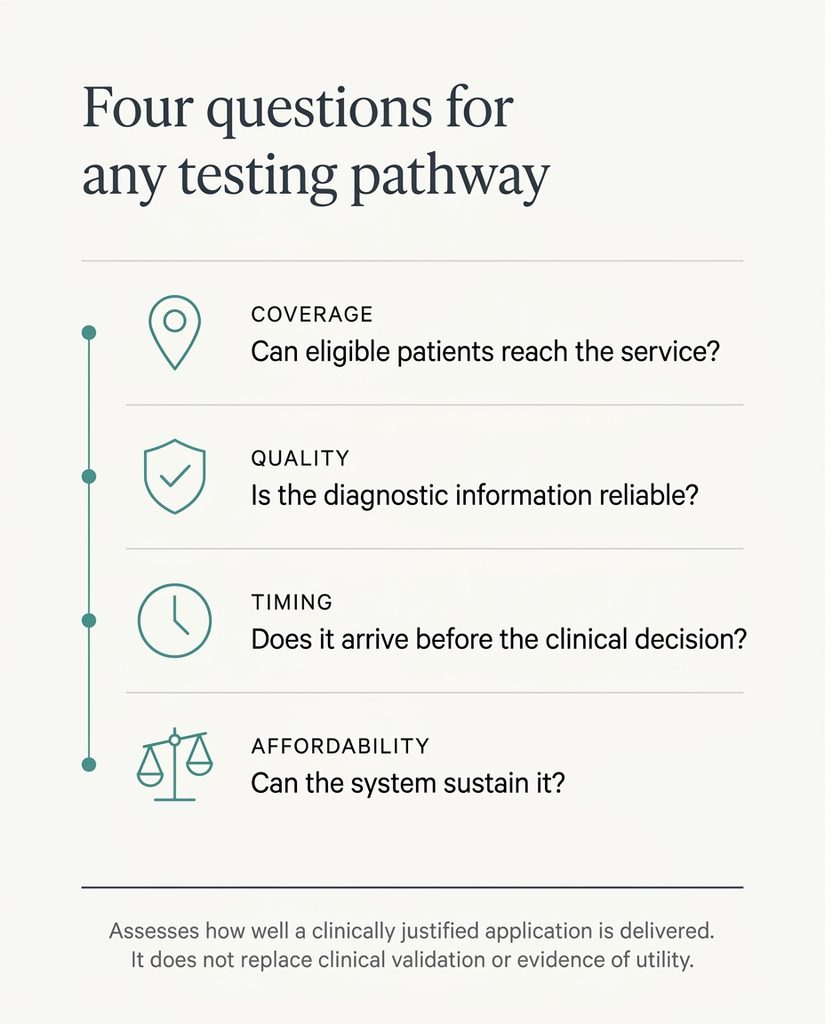
Can eligible patients reach the service? Is the diagnostic information reliable? Does it arrive before the clinical decision is made? Can the system sustain it? The questions assess how well a clinically justified application is delivered. They do not replace clinical validation or evidence that acting on the information improves care.
They also sort the evidence above. The OECD finding concerns coverage and affordability. The US figure concerns timing, together with the ordering and sampling practices that precede it. Manufacturers see placements and reagent consumption, and rarely see a patient’s journey. Hospitals and laboratories hold that data, so the questions can be answered only together with them, through aggregate measures that both sides can share.
What it costs to run a testing service
Diagnostic economics follows a different logic from drug pricing. The cost of a service depends on testing volume, platform utilization, staffing, quality requirements, maintenance, specimen logistics and whether testing is local or outsourced. Early in an application’s life, volumes are low and specialist investment is high. Automation, experience, higher utilization and competition spread fixed costs over more patients and lower the cost of each one. Costing evidence shows how the number of biomarkers changes the balance between next-generation sequencing (NGS) and sequential single-gene testing, with break-even points around 10 to 12 biomarkers in one multicountry study [12]. That finding belongs to its test mix and cost assumptions, and it favours no single technology.
The market must stay open, and competition must be allowed to come in. Where suppliers compete for laboratories and laboratories can choose platforms and contracts, efficiency gains are more likely to reach laboratories and health systems, and nobody has to prescribe how they are shared. Manufacturers earn the returns that fund development, regulatory work and technical service, and providers decide for themselves.
Make or buy, capital or operating expenditure: each provider decides on the advantages and disadvantages of each option at that moment, according to its own preferences. A hospital may build a local capability, buy testing as a service from a reference laboratory or from a proprietary specialty laboratory (Natera and Guardant Health are examples), purchase an instrument, or obtain the capacity through reagent rental or a per-test model. A lower reagent price does nothing for a hospital that cannot finance the equipment, and an instrument placed where the workflow cannot sustain it will sit idle. The goal is to serve the patient fast while defending the organization’s own interests, and industry’s task is to offer options that make both possible.
Clinically necessary tests with low volume can be unattractive to supply or hard to run locally. Reference laboratories, which pool volume from many hospitals, are the usual answer.
Who pays for it
Funding is a separate question from cost, and it is a function of the country. Health systems pay for testing through budgets, codes, tariffs, insurers or contracts with reference laboratories, and the mechanism that fits one country rarely fits another. The obligation is the same everywhere. A health system has to provide a solution so that every patient who needs a test can have it, including the poorest, using whichever mechanisms suit its context. Authorization does not settle this. In the EU, CE marking gives access to the market, while reference reimbursement and the indications covered remain with each member state, and a send-out test is paid for country by country. Samples and data that cross borders bring logistics, time and data-protection requirements that a central laboratory has to design for. Under the IVDR, tests made and used within a health institution follow in-house rules, and a test offered beyond that institution generally needs the full conformity route.
Industry can help by understanding the local mechanism and proposing workable options. In Europe, reimbursement was cited as a barrier by 59% of respondents for multigene techniques and 24% for single-gene techniques [13], so funding grows harder as methods broaden and is present for simpler methods too. When authorities assess a biomarker-directed medicine, the testing requirement and a realistic service budget should be assessed at the same time. Health technology assessment bodies are the sober voice in that process: they ask whether the evidence supports the funding, and industry does well to engage them early and to bring evidence on clinical utility and on the cost of the service.
What industry can do for real-world access: lessons from HER2
Industry can improve each of the four dimensions:
- Coverage. It builds networks of laboratories, reference services and channel partners that bring testing within reach of more patients.
- Quality. It offers standardized and automated methods, training, application support and participation in external quality programmes, on top of the guidelines and quality assurance that professional bodies provide.
- Timing. It contributes workflow automation, logistics and technical service that shorten the path from sample to diagnostic information.
- Affordability. It brings competition, higher utilization and commercial models that fit each provider’s budget.
HER2 shows these at work [14]. Automated immunohistochemistry (IHC), in situ hybridization, external quality programmes and sustained pathologist education turned a demanding application into a dependable service. I was involved commercially in introducing VENTANA’s automated 4B5 HER2 IHC assay into laboratories that used the established HercepTest approach. The biomarker was the same, and the task was changing the method used to assess it. I was on the vendor side of that competition, and I say so because it shapes what I took from it. Pathologists need confidence in classification, analytical performance, staining reproducibility, workflow integration and confirmatory testing, and winning that confidence takes the whole laboratory service. Competition between methods also widened the choices laboratories had. I also took part, from the Diagnostics side, in a HER2 testing-quality initiative with Roche Pharma colleagues, which showed that Pharma-supported education and quality programmes can raise laboratory standards when clinical independence is protected.
A laboratory buys confidence in diagnostic information, and industry’s contribution is the training, support and service that turn an assay into a working service on all four dimensions.
A global frame with local execution
A launch needs two levels, and each works best when it does what it is placed to do. The global team sets the frame. It makes testing access a launch requirement, expressed through the four questions. It provides the partner framework, the evidence and education material, and the common indicators, and it keeps an escalation path with resources behind it. It also takes the readiness of the testing route into account when it sequences markets and allocates resources. The country team tests that frame against reality: which laboratories exist, how testing is paid for, who can coordinate the route and which interim solution is feasible.
Information has to travel both ways. Countries report gaps early, and the global team resolves what repeats across markets and shares what works elsewhere. Having worked in and followed global diagnostics for some time, I have seen that the best plans are set at global level and executed by country teams who know their own market. A solution found in one country can be reused in another when both work from the same frame.
Someone coordinates the route
The route belongs to the health system. Hospitals, laboratories and payers decide how testing is organized, funded and used. Where the system has not yet organized it, a launching company can take the lead in coordinating the work, and that is the role described here.
A biomarker-directed medicine reaches patients only when a testing route works in each market, and in each market a named person in the launching company coordinates the effort to make that happen from day one. In Pharma this is a country role, typically the market access, medical or commercial lead for the medicine, supported by the company’s diagnostics experts. The Diagnostics manufacturer has a counterpart: the country or regional lead for the assay. These coordinators do not decide what belongs to hospitals, laboratories or payers. They are accountable for knowing which of the four questions the market answers well and which it does not, for bringing the institutions that can close each gap around the table, and for escalating what remains open, internally to the global team and externally to hospital management, payers and authorities.
Diagnostic readiness deserves the same management attention as therapeutic launch readiness, even though several organizations carry it out. The launch plan identifies the intended testing service in each market, the institutions that provide it and the obstacles that remain. Deployment goals follow the four criteria, with indicators, targets, a dashboard and regular reviews for each market, and they can be executed through the company’s own teams or through third parties. Partners are chosen for the service they deliver: manufacturers, reference laboratories, specialty laboratories, service providers and channel partners with clear obligations, working as an ecosystem focused on patients. Partners answer for the service obligations they control. Patient-level outcomes and the dashboard are built and reviewed jointly with hospitals and laboratories.
The four questions decide what is already operational. A launch can proceed while the route is built where they show that eligible patients can already be tested in practice, because delay would hurt them. Where they show no workable route, the coordinator pursues an interim referral arrangement with a laboratory partner wherever that is feasible, and shares a dated plan with the healthcare partners involved. Such arrangements respect clinical independence, the choice of patients and clinicians, and the rules that govern industry’s dealings with healthcare providers.
While Pharma does not control hospital budgets, and Diagnostics companies do not set reimbursement, they have the capacity to implement coordinated plans that promote best practice and move decision makers towards a working system that assures the best care for people with cancer. The demand concerns coordination and visibility, which a launching company can supply. Revenue, placements and assay utilization remain essential measures of a viable business, and they gain meaning when read next to coverage, quality, timing and affordability.
Part III — The next wave: who designs the system alongside the science?
The next applications raise the stakes
Resistance profiling, MRD monitoring, longitudinal monitoring and screening change the economics. Repeated testing multiplies sampling, capacity, reporting and cost, and affordability has to hold for every sample over months or years. Timing becomes a schedule. Coverage means reaching the same patient again and again. Screening adds population scale and the cost of acting on every finding. Maturity differs by application and indication: some have defined clinical uses, and others, such as multi-cancer early detection, are still building the evidence for clinical use.
Clinical utility needs particular attention here. For an established companion diagnostic, the clinical benefit has been demonstrated within a specific treatment-selection strategy, and a different assay or population can still need further evidence. For emerging applications of MRD testing, longitudinal molecular monitoring and multi-cancer early detection, whether acting on the information improves decisions and outcomes may still need to be demonstrated in the intended clinical setting, and a widely available, affordable assay has little value until it is. ASCO’s 2026 guideline on ctDNA testing reflects this: it recommends testing outside a trial only where the results could inform clinical decisions, and it leaves the role of MRD testing in solid tumours open [11]. Health technology assessment bodies will ask for that evidence, and they are right to: they keep the discussion anchored in value for patients and for the system. A clinically valuable test can reach the market well before most hospitals can use it effectively, so the service model, the partner structure and the data arrangements belong in the development plan from the start.
A system in permanent transition
Cancer diagnostics will not settle on one delivery model. Many advanced ctDNA-based MRD applications are currently delivered through specialized central laboratories. Tumour-informed approaches typically require initial tumour profiling and patient-specific assay design, which favours specialist services. Tumour-naïve approaches use predefined panels and can simplify assay deployment, although the sensitivity required may demand deeper sequencing and sophisticated analysis [10]. The balance between central and distributed delivery will depend on assay design, clinical validation, testing volume and economics. Other tests run in hospital laboratories, and many will move between the two as they mature. Companies such as Roche and Thermo Fisher Scientific, for example, offer kits and instruments that bring molecular testing into the hospital laboratory. In Europe I see laboratories welcoming control of their own testing, and I expect sequencing to follow the path of PCR, with falling costs and broader competition. The analysis that runs on top of the sequence is harder to replicate, and licensing is already one of the ways it reaches local laboratories.
Proprietary specialty laboratories are a distinct business model. Natera and Guardant Health are examples of companies that develop the test, generate the clinical evidence, work on reimbursement and operate the laboratory, so one party is accountable for the whole service. This differs from a reference laboratory that performs other people’s tests. Some of these technologies will stay central, and others will be licensed or deployed through additional laboratories as volumes and local needs grow. What matters for patients is that the service reaches all eligible patients wherever the clinical need exists, and that the route can widen when demand requires it.
Customers choose differently. University hospitals with a clinical research department next to the laboratory often want to keep the data. Other providers prefer a clean send-out with a good report and a single payment per case. Both choices are reasonable and both can serve patients well. Proprietary services face competition like any other offer, and a patient who is being followed up creates a continuity need that providers and suppliers can address through commercial arrangements.
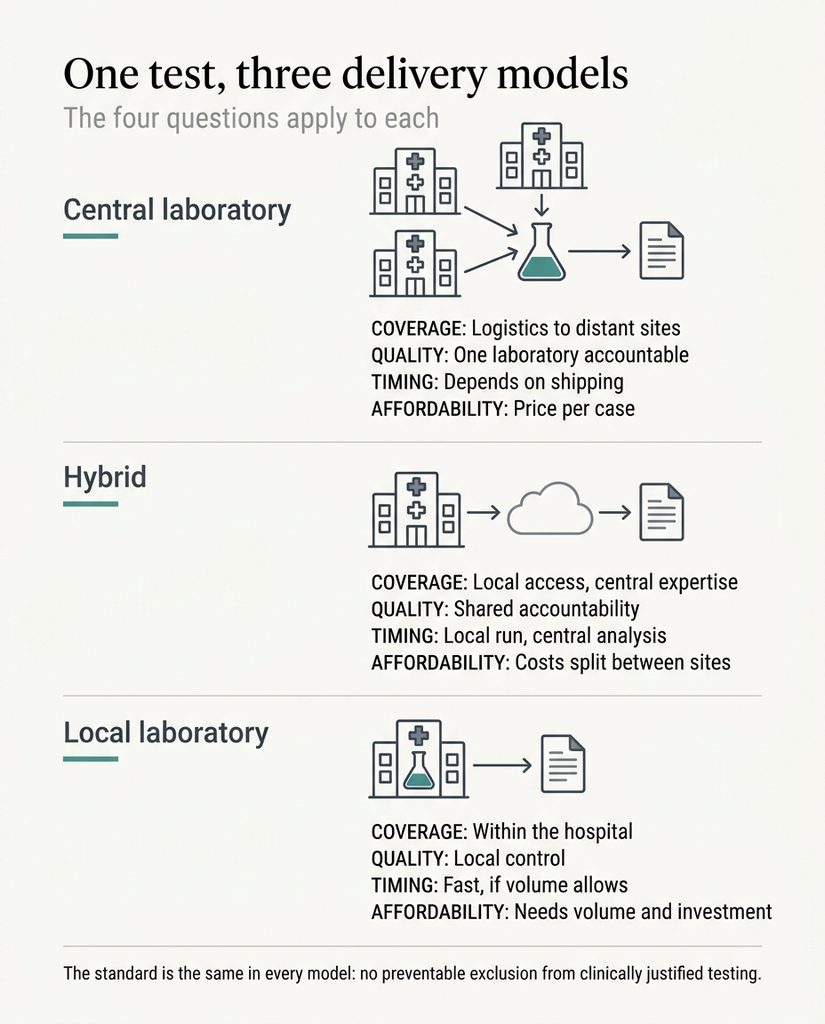
The standard is the same in every model: clinically justified testing should not leave patients out for preventable reasons. Technology, validation requirements and economics differ between models, and each gives its own answers to the four questions. A central laboratory has to reach patients in distant hospitals inside the decision window, and a local laboratory has to sustain quality and cost. Gaps can open at the transitions, when a test changes where it runs and nobody coordinates the change.
Co-development or commissioned development
The companion diagnostic named in a medicine’s label makes this decision critical. Foundation Medicine and Agilent are examples of Diagnostics companies whose tests are named in the labels of several medicines, and for those medicines treatment access depends on an appropriate testing route. For other applications, such as MRD or profiling outside a medicine’s label, the connection to treatment-launch readiness is less direct, although the clinical and commercial importance can still be substantial.
Contracts for companion diagnostics combine many features: development funding, milestones, platform access, retained background IP, licences, territorial rights and shared commercial responsibilities. To make the choice visible, I reduce it to two ends of the range. In co-development, a Diagnostics developer invests alongside the drug programme and expects a return from its platform. In commissioned development, the sponsor pays for the work as a service and negotiates what it keeps.
I suggest that Pharma consider the commissioned end alongside co-development, because it can preserve options for future diagnostic access through licensing and additional providers. Ownership alone guarantees nothing. Technology, software, regulatory documentation and evidence have to be transferred or licensed, and every additional assay needs its own evidence and authorization. Technology transfer to additional manufacturers and the complementary rollout mechanisms, such as reference laboratories and distribution, need to be thought through well in advance, so that full access downstream is facilitated and nobody improvises it after launch. The interest of the patient who needs a test in every market where the medicine is sold comes first, and that may sometimes mean the sponsor carries a larger share of development costs. Co-development brings platform investment and speed, and the developer has sound reasons to want a market wider than one drug programme. Each case is its own case, and the principle holds in both: keep the way open to qualified providers.
Exclusivity belongs to the same decision. The aim is to set the deals in a way that the market offers adequate choices to all: patients, laboratories and health systems. Exclusivity takes several forms, and a limited arrangement can justify an early platform investment or bring forward a test that nobody would otherwise build. It works best when its scope and duration are proportionate to that contribution, and when the agreement provides for how further qualified providers can join as volumes and market demand grow. HER2 shows what competition between validated methods did for laboratories’ choices, and Pharma gains too, because every patient who can be tested is a patient who may qualify for treatment.
Control is distributed: coordination is needed
As testing becomes more digital and longitudinal, the diagnostic information a clinician receives is produced by a chain of connected activities: collection, laboratory analysis, bioinformatic processing, interpretation and reporting. Strategic control is spread across analytical platforms, algorithms, data, clinical pathways and commercial channels. Pharma has a strong interest in these components and often controls few of them. Diagnostics developers hold independent technical, regulatory and commercial positions of their own.
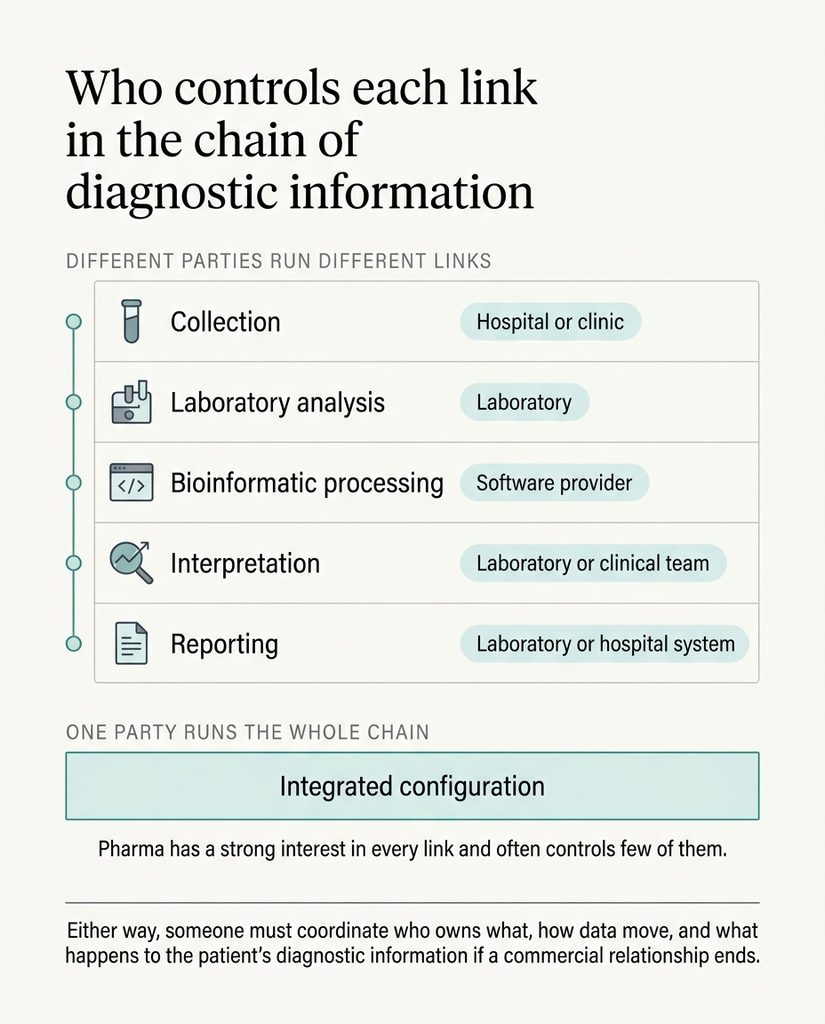
Tempus and SOPHIA GENETICS are examples of how the layer above the sequence can be built: Tempus develops analysis and data capabilities on top of sequencing, while SOPHIA GENETICS offers analysis software that hospitals can use locally. Both show that this layer can be offered as a service or licensed, and each choice changes who controls what. A company that runs the whole chain from collection to reporting is one workable configuration, with a single accountable party. The questions apply to every configuration. Who owns the method and the software? Who may use the evidence generated in development? Who is responsible when an algorithm changes? Can a laboratory still interpret its historical data after changing supplier? The answers decide whether patients keep receiving diagnostic information when a commercial relationship ends.
Where control is spread across this many parties, coordination becomes the executive task: agreeing who owns what, how data and evidence move, and what happens to the patient’s diagnostic information when a commercial relationship ends. No single model suits every case, and every case needs that coordination designed in advance.
Channels carry the service
Cancer diagnostics is a partnership business, and its partners work best as an ecosystem focused on patients. I have spent a good part of my career designing and rolling out distribution systems, and I come to this need naturally and with enthusiasm. Engaging third parties is often the best choice. To serve the global market fully, smaller and larger companies alike need channel partners of various kinds, depending on the business and the market.
In cancer diagnostics, channels deal with classic diagnostic systems and, increasingly, with services and informatics licences that require a different set-up: implementation, connectivity, validation, training, software maintenance and data handling. When properly selected and developed, channel partners provide a good service at a fair cost to manufacturers. Cancer diagnostics already has active channel partners. Some come from life sciences distribution, and others are closer to Pharma and suited to calling on laboratories and on clinical services as well. I do not see channels as an obstacle in cancer diagnostics.
Service-based testing adds another channel form, lab-to-lab business. One laboratory relies on another to perform the test, while it keeps the relationship with the clinician and bills the patient, the insurer or the health system, or a combination of them. It works differently from the distribution of instruments and kits, and in many countries it is how specialized testing reaches the patient.
Partners answer for the service obligations they control, and whether eligible patients were reached in time is a question for joint review with healthcare institutions. Temporary support can remove an early barrier, and a lasting partnership leaves the laboratory able to operate through its normal budget, procurement and quality processes.
Pharma and Diagnostics executives can influence patient benefit long before an innovation becomes routine care. Their decisions on development partnerships, intellectual property, data control, service delivery and market access determine how readily a clinically valuable application can reach patients, and those decisions belong in development and not after clinical demand has emerged.
Conclusion — Who turns innovation into patient benefit?
Pharma and Diagnostics industries are making significant efforts to bring the benefits of innovation to people suffering from cancer, and the system around those efforts can be made to work better.
Scientific understanding keeps evolving, and new technologies create possibilities before clinical practice can accommodate them. Research will keep running ahead of routine care. Cancer diagnostics will keep moving towards a new normal, and each version of it has to avoid preventable exclusion from clinically justified testing.
Nobody does this alone. Clinicians, laboratories and health systems make diagnostic innovation part of care, and they decide on clinical use, funding and organization. The leaders of Pharma and Diagnostics hold the part that comes before and around that: designing how a test is co-developed or commissioned, how many providers can deliver it, who holds the data and the algorithms, which partners carry the service and who coordinates the route in each market. Diagnostic innovation reaches patients when technical capability, clinical adoption, financing and partnerships work together, and open competition and transparent contracting keep the economics sustainable.
The patient at ESMO had to find her own way. For patients whose treatment already depends on an established biomarker, the testing route should be in place, with someone coordinating it, before they arrive. The industry has shown that it can build such services, and the next generation of diagnostics gives it the chance to do so from the start of development.
Views are my own. The companies named are examples among many, and my career in diagnostics has included roles at some of them.
References
- Gueguen L et al. A prospective pragmatic evaluation of automatic trial matching tools in a molecular tumor board. npj Precision Oncology 9, 28 (2025). https://doi.org/10.1038/s41698-025-00806-y
- ESMO. Calls for urgent action to safeguard oncological research in Europe (2024). https://www.esmo.org/society-updates/esmo-calls-for-urgent-action-at-both-eu-and-national-levels-to-safeguard-the-future-of-oncological-research-in-europe
- European Commission. Proposal for a Regulation amending Regulations (EU) 2017/745 and (EU) 2017/746, COM(2025) 1023 final (16 December 2025). https://eur-lex.europa.eu/legal-content/EN/TXT/?uri=celex:52025PC1023
- US Food and Drug Administration. Breakthrough Devices Program. https://www.fda.gov/medical-devices/how-study-and-market-your-device/breakthrough-devices-program
- US Food and Drug Administration. Medical Devices; Laboratory Developed Tests: rescission of the 2024 final rule. Federal Register (19 September 2025). https://www.federalregister.gov/documents/2025/09/19/2025-18239/regulation-identification-number-0910-aj05-medical-devices-laboratory-developed-tests-implementation
- EFPIA. Response to the European Commission’s targeted revision of MDR/IVDR (2026). https://efpia.eu/news-events/the-efpia-view/efpia-news/efpia-response-to-ec-targeted-revision-mdrivdr-have-your-say/
- MedTech Europe. MDR/IVDR revision: a regulatory system at a crossroads (2026). https://www.medtecheurope.org/2026/05/05/medtech-europe-backs-eu-device-regulation-overhaul-but-asks-key-changes/
- OECD. Access to oncology medicines in EU and OECD countries. OECD Health Working Papers No. 170 (2024). https://doi.org/10.1787/c263c014-en
- Thomas CA et al. Evaluating effective biomarker testing for advanced non-small cell lung cancer in US community oncology practices. JCO Oncology Practice (2026). https://doi.org/10.1200/OP-25-01007
- Pascual J et al. ESMO recommendations on the use of circulating tumour DNA assays for patients with cancer: a report from the ESMO Precision Medicine Working Group. Annals of Oncology 33(8), 750–768 (2022). https://doi.org/10.1016/j.annonc.2022.05.520
- Lockwood CM et al. Circulating tumor DNA testing in solid tumors and lymphoma: ASCO guideline. JCO Oncology Practice (published online 18 June 2026). https://doi.org/10.1200/OP-26-00311
- Malapelle U et al. Costs of biomarker testing in advanced NSCLC: a global comparison of NGS and single-gene testing. Journal of Pathology: Clinical Research (2025). https://doi.org/10.1002/2056-4538.70018
- Bayle A et al. ESMO study on the availability and accessibility of biomolecular technologies in oncology in Europe. Annals of Oncology (2023). https://doi.org/10.1016/j.annonc.2023.06.011
- Robbins CJ, Bates KM, Rimm DL. HER2 testing: evolution and update for a companion diagnostic assay. Nature Reviews Clinical Oncology 22, 408–423 (2025). https://pmc.ncbi.nlm.nih.gov/articles/PMC12903097/
- Pascual J et al. ESMO recommendations on the use of circulating tumour DNA assays for patients with cancer: a report from the ESMO Precision Medicine Working Group. Annals of Oncology 33(8), 750–768 (2022). https://doi.org/10.1016/j.annonc.2022.05.520
- Lockwood CM et al. Circulating tumor DNA testing in solid tumors and lymphoma: ASCO guideline. JCO Oncology Practice (published online 18 June 2026). https://doi.org/10.1200/OP-26-00311
- Malapelle U et al. Costs of biomarker testing in advanced NSCLC: a global comparison of NGS and single-gene testing. Journal of Pathology: Clinical Research (2025). https://doi.org/10.1002/2056-4538.70018
- Bayle A et al. ESMO study on the availability and accessibility of biomolecular technologies in oncology in Europe. Annals of Oncology (2023). https://doi.org/10.1016/j.annonc.2023.06.011
- Robbins CJ, Bates KM, Rimm DL. HER2 testing: evolution and update for a companion diagnostic assay. Nature Reviews Clinical Oncology 22, 408–423 (2025). https://pmc.ncbi.nlm.nih.gov/articles/PMC12903097/