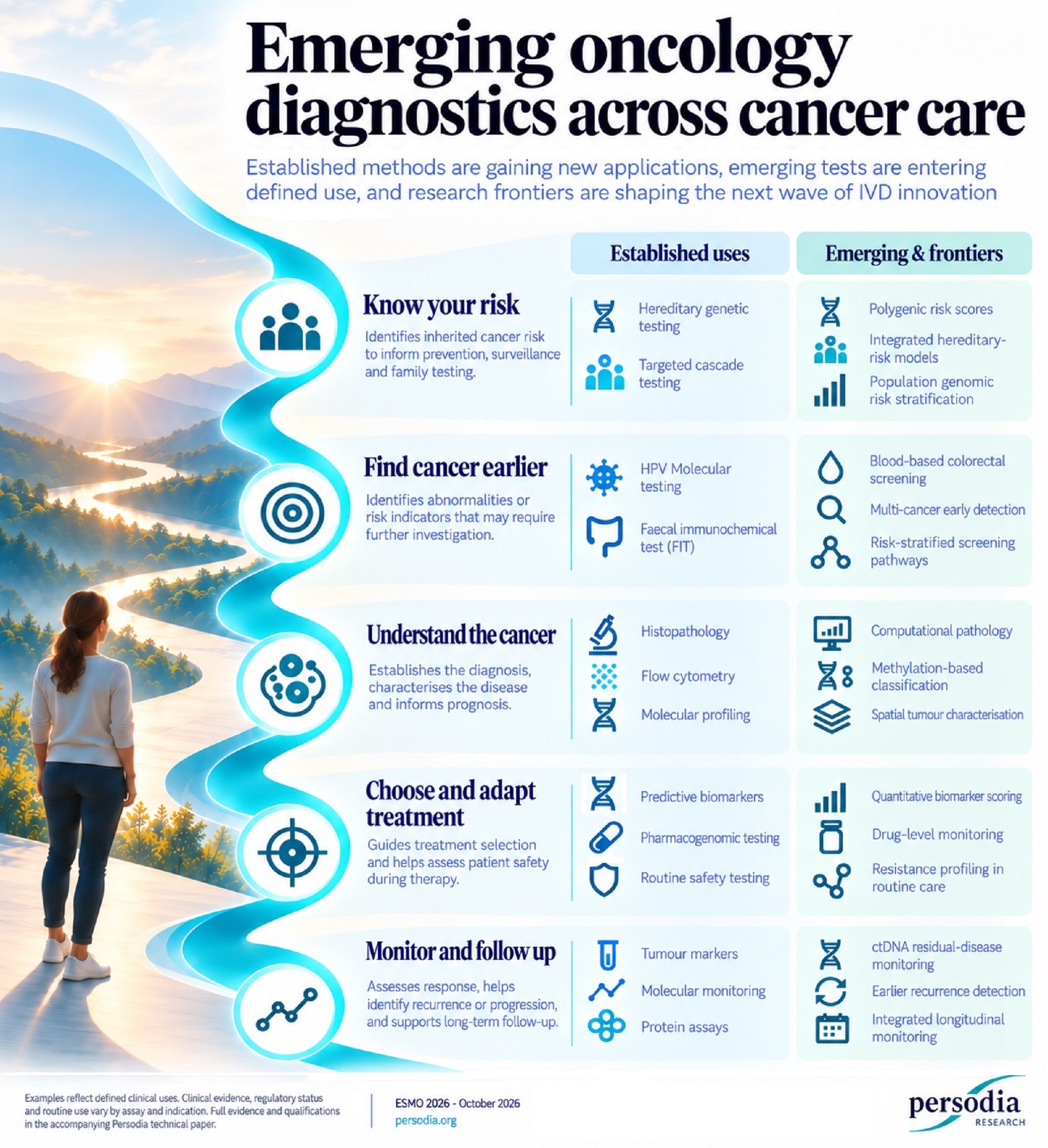
Where established platforms and emerging applications can create new clinical value through 2031.
Oncology diagnostics is entering a new phase. Established methods are gaining new clinical applications, selected emerging tests are moving into defined use, and research frontiers are beginning to shape the next wave of IVD innovation. Across risk assessment, early detection, tumour characterisation, treatment and follow-up, the question is no longer only what diagnostics can detect, but which applications are likely to create meaningful clinical value by 2031, at what scale, and through which industrial pathways. This article looks at that shift from an IVD-industry perspective, using Persodia’s curated evidence map of 66 oncology diagnostic applications to distinguish what is already established, what is emerging, and where the next opportunities for specialised services and scalable IVD solutions are likely to appear.
A blood test for colorectal cancer received US FDA approval in 2024. A different blood-test concept—screening for many cancers at once—has produced a more complicated evidence story. The randomised NHS-Galleri trial missed its primary endpoint for reducing the combined incidence of stage III–IV cancers. In September 2026, an FDA advisory panel nevertheless voted favourably on Galleri’s benefit–risk profile. That vote was advice to the agency, not marketing approval. [1–3]
These developments concern different tests, purposes and populations. They also pose a strategic question for the IVD industry: which advances can add clinically useful information, for whom, and at what scale? Analytical innovation offers new possibilities; clinical evidence determines the applications that manufacturers and specialised testing services can bring into practice.
Across modern cancer care, IVD products and laboratory-developed methods already inform inherited risk, screening, disease characterisation, treatment and follow-up. By 2031, the strongest advances are likely to come through three different routes: established methods gaining new indications, promising applications becoming routine in defined settings, and research frontiers progressing towards clinical utility.
A broad foundation—and a qualified research map
Persodia reviewed 66 curated oncology diagnostic applications across five stages of the patient journey: risk assessment (4), early detection (9), tumour diagnosis and characterisation (16), treatment decisions and safety (22), and monitoring and follow-up (15). The maturity classifications cover 36 routine-established, 18 selective or conditional, five product-authorised and seven emerging applications.
| Cancer-care stage | Applications reviewed | Established foundation | Selected advancing applications |
|---|---|---|---|
| Risk assessment | 4 | Germline cancer-risk testing; familial-variant testing | Polygenic risk scores |
| Early detection | 9 | HPV molecular testing; FIT screening | Blood-based colorectal screening; multi-cancer early detection |
| Tumour diagnosis and characterisation | 16 | Histopathology; immunohistochemistry; molecular profiling | Computational pathology; quantitative tissue interpretation |
| Treatment decisions and safety | 22 | Predictive biomarkers; pharmacogenetics; drug-exposure monitoring | Expanded biomarker indications; more individualised exposure-guided dosing |
| Monitoring and follow-up | 15 | Established tumour markers; molecular monitoring | Solid-tumour ctDNA; molecular residual-disease applications |
| Total | 66 |
An established technology may gain new indications, while novel methods can already serve specific clinical uses. Research-stage approaches such as spatial profiling and proteogenomics sit in a separate annex, outside the 66-application count.
The more revealing view is what changes across the patient journey.
Horizon 1 — Established capabilities gain new clinical value
2031 outlook: high confidence. The largest near-term expansion is likely to come from technologies already present in clinical laboratories.
For inherited risk, pathogenic-variant testing and targeted family testing already support surveillance and prevention. In screening, HPV tests and faecal immunochemical tests have established roles in defined programmes. Progress here often means better coverage, risk-appropriate use and completion of the clinical pathway.
In tumour characterisation, histopathology, immunohistochemistry (IHC), flow cytometry and molecular profiling form a substantial clinical foundation. More therapies and more precisely defined indications can increase the clinical value of assays laboratories already know how to perform. ESMO’s 2024 update expanded its recommendations for next-generation sequencing (NGS) to additional advanced cancers and selected rare tumours, illustrating this trajectory. [4]
For treatment, predictive biomarkers work alongside routine blood counts, organ-function testing and pharmacogenetics to support efficacy and safety. During follow-up, established disease-specific markers and quantitative molecular monitoring—including BCR::ABL1 in chronic myeloid leukaemia—already inform longitudinal management.
Manufacturers with validated assays, installed systems and extensible menus are well positioned to serve additional indications as new therapies give established platforms greater clinical relevance.
Horizon 2 — Emerging applications reach selected clinical decisions
2031 outlook: selective expansion, with moderate confidence. Several advances are crossing from analytical promise into defined clinical use, but their maturity varies sharply by indication.
At the risk-assessment stage, polygenic risk scores may complement family history and clinical factors in more personalised cancer screening. Their readiness for routine use depends on prospective outcomes, performance across ancestries and equitable implementation. [5]
For early detection, the FDA-authorised Shield test provides a blood-based colorectal screening option for average-risk adults aged 45 and over, with colonoscopy needed after a positive finding. Multi-cancer early detection (MCED) is another emerging clinical application, with a pending US premarket application and a distinct evidence challenge: in NHS-Galleri, the randomised trial did not meet its primary endpoint for reducing stage III–IV cancer incidence across 12 prespecified cancers. The favourable September 2026 FDA advisory vote concerned benefit–risk, not marketing authorisation. [1–3]
In tumour characterisation, computational pathology can support defined tasks. Paige Prostate has US FDA De Novo authorisation, and Tempus reports EU IVDR certification obtained in 2025. These product-specific milestones establish concrete clinical entry points for AI-assisted pathology. More quantitative tissue-marker interpretation could become valuable as treatments create new distinctions within existing expression categories. [6, 14]
The treatment stage includes an important opportunity: measuring drug exposure to inform dosing. Serum methotrexate monitoring is part of established high-dose methotrexate protocols; fluorouracil exposure-guided dosing has specialist recommendations; and imatinib therapeutic drug monitoring has international consensus guidance, with more variable adoption. The expansion opportunity lies in regimen-specific, clinically meaningful dosing decisions. [7, 12, 13]
For follow-up, solid-tumour circulating tumour DNA (ctDNA) is moving from recurrence-risk assessment into selected treatment-guiding uses. The 2026 US authorisation of Signatera CDx with adjuvant atezolizumab after cystectomy in a defined molecular-residual-disease-positive bladder-cancer population provides one indication-specific example. [8]
By 2031, selected blood-based tests, quantitative pathology applications, drug-level monitoring and molecular residual-disease methods are likely to reach additional defined populations. Small cohorts will often favour specialised testing services; wider indications can support distributed IVD solutions.
Horizon 3 — Research frontiers confront the clinical-outcome test
2031 outlook: substantial scientific progress; broad routine deployment uncertain. Spatial tissue profiling, multiplex immune phenotyping, proteogenomics, extracellular-vesicle assays and longitudinal molecular-response algorithms could expand what diagnostic information describes.
Their importance will be determined by the clinical decision they improve and the evidence that acting on their information adds patient benefit.
These approaches may describe cellular context, heterogeneity and disease evolution more richly than current methods. The research annex identifies them as future-oriented technologies whose clinical applications still need validation.
By 2031, the strongest advances here are likely to be discovery, translational validation and selected clinical applications, with broad routine uptake remaining uncertain.
Integration is the multiplier across the patient journey
The greatest gains may come when diagnostic information is usable across encounters rather than confined to individual laboratory reports.
A hereditary-risk assessment can inform surveillance. Tissue and genomic findings can inform a treatment choice. Pharmacogenetic and biochemical information can support safe administration. Later molecular measurements may contribute to evaluating response, resistance or recurrence. Each carries a different analytical method, specimen context, uncertainty and clinical meaning.
A longitudinal view must preserve those distinctions. For manufacturers, that places growing value on interoperable systems, robust quality controls, traceable analytical metadata and methods that retain their clinical meaning when information moves across institutions. The European Health Data Space provides an important infrastructure horizon: many secondary-use provisions begin applying in 2029, with cross-border exchange requirements for laboratory information following in 2031. The quality and governance of the information will determine its practical value. [9]
Progress should be measured through appropriate testing coverage, time to actionable diagnostic information and the proportion of indicated clinical decisions incorporating it.
The IVD industry: specialist innovation and scalable deployment
Oncology already represents a substantial IVD opportunity. Preliminary Persodia/GIMI modelling suggests an extended oncology-related manufacturer-revenue market of about USD 20 billion in 2025, or roughly 15% of its defined eligible IVD perimeter. This includes cancer-specific products and an estimate of oncology use of shared tests such as haematology and clinical chemistry. The estimate is unpublished, model-based and provisional; oncology-attribution assumptions remain under validation. It is a directional measure, not an audited market total.
Expansion will follow two complementary routes, largely determined by the size and clinical concentration of the target population.
For small patient cohorts and highly specialised questions, expert laboratories—including selected reference laboratories, academic centres and specialised diagnostic-service companies—will continue adapting powerful life-science tools into validated, proprietary testing methods. In markets using the term, these may be offered as laboratory-developed tests (LDTs): commercialised specialist testing services, rather than generally distributed IVD kits. European in-house testing operates under distinct IVDR conditions. The opportunity is to translate research methods into clinically reliable diagnostics for populations too small or complex to justify immediate industrial-scale product development. [10]
When indications broaden and demand becomes more predictable, the commercial opportunity shifts towards industrialised IVD solutions: standardised reagents and assays, automated workflows, validated software, quality assurance and technical support that can be deployed across hospital, regional and other decentralised clinical laboratories. In this context, decentralisation means adoption by hospital and regional laboratory networks; technically complex and low-volume applications can remain centralised.
The underlying innovation supply is unusually strong: sustained cancer-drug R&D, next-generation sequencing, digital PCR, multiplex tissue imaging, advanced proteomics, mass spectrometry and computational pathology. It is reinforced by major public and philanthropic cancer programmes and a continuing societal commitment to confront a disease responsible for an estimated 20.6 million new cases and 9.8 million deaths worldwide in 2024. [11]
Price pressure across established IVD markets constrains investment, while clinical evidence, regulatory compliance and market access remain costly. Larger manufacturers can scale through installed platforms and international service capacity; smaller innovators and specialist testing companies contribute technologies and targeted clinical applications. Oncology offers an unusually strong basis for investment across both models, provided innovation can be financed and reliably deployed.
What will matter by 2031
The most confident outlook is that established IVD platforms will serve more indications. Selected emerging applications will become routine in defined cancer populations, while frontier technologies will continue generating the next wave of clinically validated methods. More specialised services and scalable product platforms should develop alongside one another, expanding the clinical reach of both.
For the IVD industry, there is good reason for optimism through 2031. Few fields combine such sustained research intensity, such a wide range of powerful analytical technologies and such clear societal demand. The opportunity is to convert this exceptional innovation base into reliable products, specialised services and diagnostic information that improves decisions across the cancer-care journey.
Selected sources
- 1. US FDA. Shield, P230009: product approval and intended use. 2024.
- 2. Sasieni P et al. Effect of Screening with Multicancer Early-Detection Test on Late-Stage Cancer Diagnosis. New England Journal of Medicine. Published online September 2026. Primary NHS-Galleri endpoint not met.
- 3. US FDA. Molecular and Clinical Genetics Devices Panel, 23 September 2026: 24-hour summary. Advisory vote; no marketing authorisation.
- 4. Mosele MF et al. ESMO recommendations on NGS in advanced cancer. Annals of Oncology. 2024.
- 5. Pezzullo AM et al. Polygenic risk scores in breast cancer screening: recommendations from the Can.Heal project. European Journal of Public Health. 2025, conference abstract. See also Roberts E, Flaum N, Evans DG, Clinical implementation of polygenic risk scores, published online 2025.
- 6. US FDA. Paige Prostate, De Novo DEN200080. 2021.
- 7. Beumer JH et al. Therapeutic drug monitoring recommendations for 5-fluorouracil. Clinical Pharmacology & Therapeutics. 2019.
- 8. US FDA. Atezolizumab and Signatera CDx in ctDNA-positive bladder cancer. May 2026; indication and CDx decision specific to the United States.
- 9. European Commission. European Health Data Space: implementation.
- 10. European Commission. In-house medical devices under MDR and IVDR Article 5(5). Distinct from the US regulatory concept of an LDT.
- 11. Sung H et al. Global Cancer Statistics 2024: GLOBOCAN estimates. CA: A Cancer Journal for Clinicians. 2026; see also IARC summary.
- 12. Bielack SS et al. European consensus on delayed high-dose methotrexate elimination. Journal of Cancer Research and Clinical Oncology. 2024.
- 13. Clarke W et al. IATDMCT consensus guidelines for imatinib therapeutic drug monitoring. European Journal of Cancer. 2021.
- 14. Tempus. Paige Prostate EU IVDR certification. Manufacturer statement, April 2026, reporting 2025 certification.
Related Documents
Remarks
Evidence and outlook note: The 66-application inventory is a curated Persodia research map, with its seven emerging entries kept separate from additional topics in the research annex. Application maturity and the 2031 scenarios are qualified analytical classifications, not estimates of clinical prevalence or prospective adoption rates. The oncology market figure is a preliminary, unpublished Persodia/GIMI product-level estimate of Core and Extended IVD manufacturer revenues, including modelled oncology use of multipurpose products; it excludes laboratory-service billings and Broad IVD (including CGM). The oncology-attribution assumptions have not been independently validated. The specialised-service and distributed-IVD pathways are Persodia’s structural judgements.