
ESMO Congress 2026 opens in Madrid on 23 October [1]. Much of the science presented there depends on a biomarker test reaching the right patient, and the exhibition floorplan shows who is lined up to make that happen. By my count, pharma and diagnostics bring almost the same number of exhibitors, 73 and 62, yet pharma takes about three-quarters of the floor and diagnostics about a tenth. About a dozen of the diagnostic exhibitors run testing services an oncologist can order. Most of the others are there for partners: a pharma company that needs a companion diagnostic, a laboratory network, a hospital, a data owner. Getting a drug approved with its test is one goal. Making sure every eligible patient is tested, reliably and in time, is another, and it is the one patients feel.
The exclusive-test paradox
The two goals can pull apart. The exclusive test that makes approval possible can later become a barrier to access: the evidence belongs to one assay, often on one platform, and laboratories with other systems must invest, send samples out or validate an alternative while eligible patients wait. For the next biomarkers, the diagnostic partnership has to be designed from the first agreement to carry testing into routine care, across laboratories, platforms and countries, so that no eligible patient misses the best treatment. Partnering to build a test is something the industry does well. Partnering to take it to patients is the part that still needs work.
What HER2 settled
Trastuzumab and HercepTest were approved in the United States on the same day in 1998, an early landmark for companion diagnostics [2,3]. Genentech worked with Dako to turn a complex clinical-trial assay into a kit that general pathology laboratories could run [4]. Laboratories, quality-assessment schemes and professional societies then built the training, quality control and shared scoring rules that made the test reliable in routine care, later formalised in the ASCO/CAP guidelines [5].
I worked on this at Roche. I promoted staining quality, helped spread the interpretation standards among pathologists, and was part of a group that assessed testing quality with one direct question: is any patient missing treatment because of incorrect testing? Roche invested in pathology training and funded testing improvement in selected locations, as a catalyst for the wider system.
When the Ventana 4B5 assay arrived, many laboratories were cautious. They became confident once they saw the staining quality and could apply the scoring protocol they already used with HercepTest. From one companion test in 1998, the field grew to 14 FDA-approved HER2 assays across IHC, ISH and NGS by 2023 [4]. When eligibility extended to HER2-low disease [6], the same network of people, quality schemes and shared rules let pathologists adapt.
What I took from it: patient access came from the partnerships that formed around the test after approval, as much as from the co-development itself.
What has changed
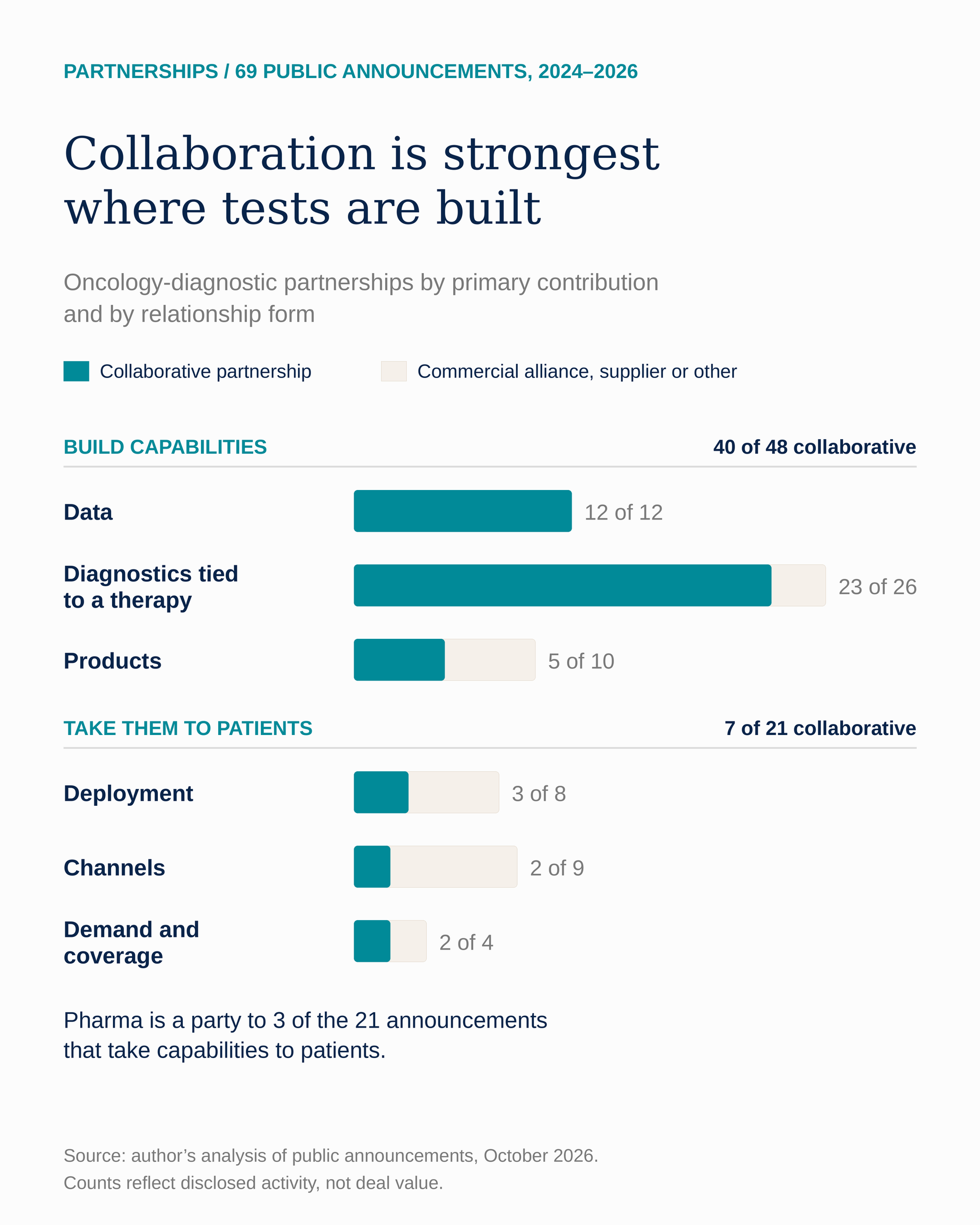
The partnerships around today’s biomarkers look different. I classified 69 public oncology-diagnostic partnership announcements from 2024 to 2026 by what each one contributes [7]. Six types emerge. Three build capabilities: data (12 announcements), diagnostics tied to a therapy (26) and products (10), and 40 of those 48 describe genuine joint work. Three take capabilities to patients: deployment in laboratories and hospitals (8), channels (9), and demand and coverage, meaning programmes that raise testing uptake or secure payment (4). Of those 21, seven are collaborative, and pharma is a party to three. The counts measure disclosed activity, not deal value, and access agreements are announced less often than development deals, so the gap may be smaller than it looks. The pattern still holds, and my reading of it is this: building a test needs two or three committed parties, while taking it to patients involves many more, each with its own incentives and few with shared governance.
The objects of partnership have changed too:
- Computational pathology. AstraZeneca and Roche have reported co-developing a computational-pathology TROP2 companion diagnostic, in which an algorithm scores the digitised slide [8]. Leica Biosystems, Indica Labs and Lunit are combining staining, image management and AI to develop algorithms for PD-L1 and emerging biomarkers [9].
- Liquid-biopsy companion diagnostics. Guardant Health and Merck (MSD) agreed a multi-year collaboration to develop companion diagnostics for new cancer therapies on Guardant’s Infinity Smart platform [10].
- Residual disease in drug development. Illumina and Janssen extended their collaboration to a whole-genome-sequencing assay for molecular residual disease, for research use [11].
- Coverage. GRAIL and Curative Insurance made a multi-cancer early-detection test available as a member benefit, bringing a payer into the partnership [12].
These are different business models. Some partnerships create the technology and the evidence; others create the conditions for it to reach patients, and the next biomarkers need both. Together they bring in parties HER2 never needed: software developers, scanner makers, data owners, payers. More parties mean more interests to align after approval, and new questions of trust. Computational pathology shows what that means in practice.
The same trust problem, with an algorithm
The 4B5 story has a direct successor. When an algorithm calculates the score, the pathologist has to trust a call made by software, and the laboratory has to run it on the scanner and image system it already has. The adoption challenge is familiar; the conditions are new. Software validation, version control, performance across patient populations and human oversight have no real equivalent in a stain. The partnership should settle them in the agreement:
- whether the algorithm will run on scanners beyond the one validated, a commercial and regulatory design choice, and who validates it if so;
- how the approved version is maintained, how its performance is monitored in routine use, and how updates are handled under IVDR and FDA rules;
- who owns, and who may reuse, the images and data generated in routine use;
- how pathologists are trained to review the score and to recognise the cases that need their judgement.
HER2 took years to answer the equivalent questions for a stain. An algorithmic companion diagnostic will reach patients sooner if its partners answer them before launch.
MET: the access question is live now
MET shows why this matters today. Two new treatments depend on MET testing. Telisotuzumab vedotin was approved in the United States in 2025 with an IHC companion test [13]. Savolitinib with osimertinib reported positive phase III results in August 2026, after progression and in first line [14,15]. MET can be measured as protein by IHC or as gene amplification by FISH or NGS, often from a small biopsy, and the two treatments may not call for the same test at the same point in the pathway.
Laboratories will need to know which test, when, and on which platform, country by country. That is a partnership question. The drug sponsors, their diagnostic partners and the laboratories have to agree the testing pathway before the first patient is tested, and keep it working after approval.
What these partnerships require: vision, diplomacy and know-how
In my recent years leading strategic partnerships at Abbott, the work started long before a term sheet: mapping which capability was missing, judging where the market, the technology and the economics made a partnership worth more than building alone, screening a dozen candidate partners against those criteria, and testing whether each side could earn its return.
Everything starts with the goal. Approval and access are different goals, and the partners have to understand and agree on both before they negotiate anything else. Once the goal is shared, designing the partnership is often less about one contract than about building an ecosystem: a diagnostics partner, laboratories, software and data providers, payers and professional societies, each holding part of what patients need. Sometimes the pharma company builds it. Often the role is to orchestrate it: making the need visible and aligning the partners better placed to act.
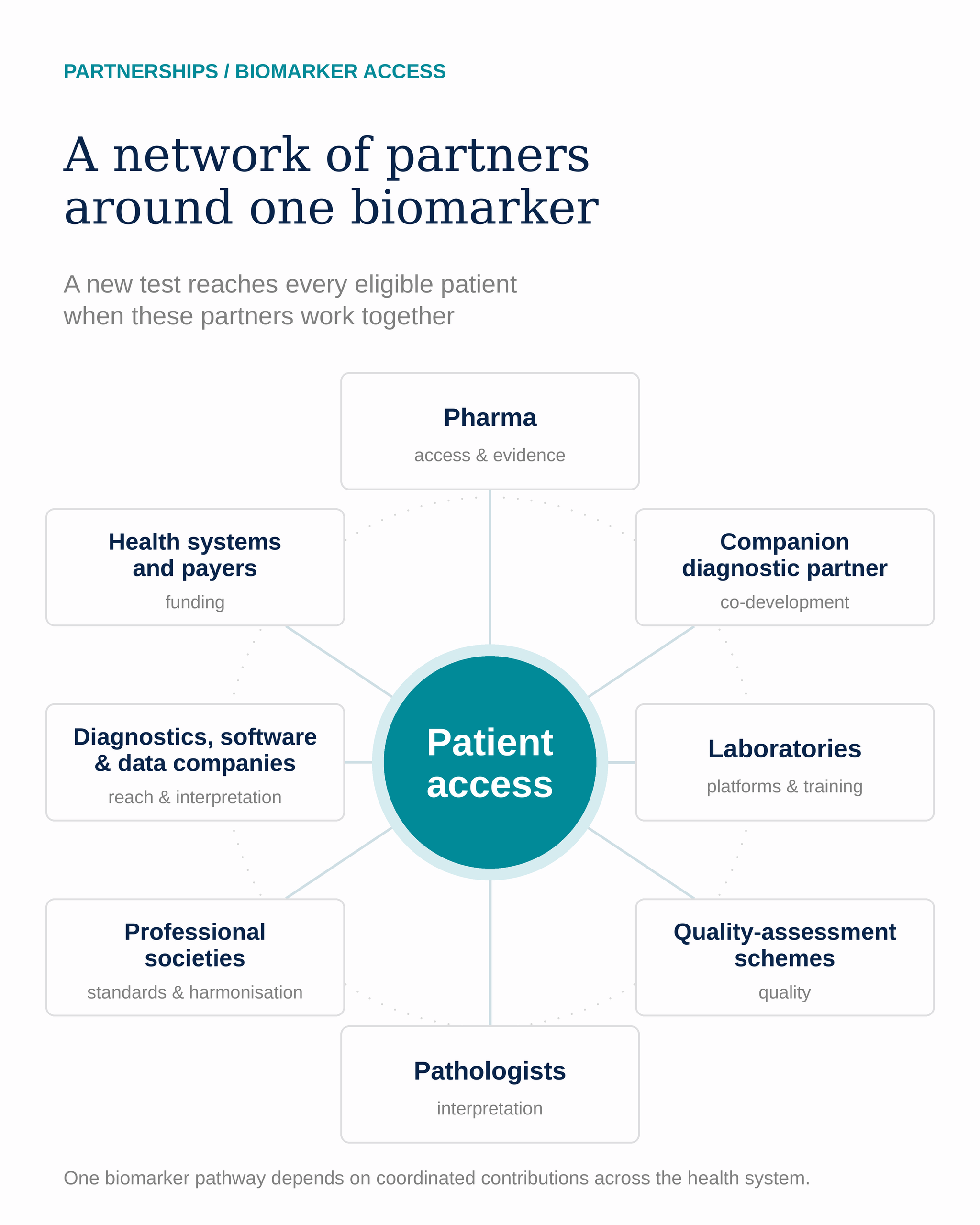
That work asks for three things. Vision, to design a partnership that serves the purpose and also works for each party, because commitment fades wherever one side carries the cost and another captures the benefit. In practice that means deciding at co-development whether the test will be a kit or a central service and when exclusivity ends, and settling who invests, who owns the data and who earns the recurring revenue. Diplomacy, to take the parties through the details until they agree: persuading a diagnostics partner to fund validation on a competitor’s platform, or bringing its field incentives into line with a low-volume test. And know-how, which builds the trust that makes the process feel safe for everyone at the table, starting with knowing which details sink an agreement late: data rights, the IVDR path, reference testing while laboratories catch up.
The partnership is judged by patient outcomes
Cancer care is a highly interdependent system. The best outcomes come when all the stars align: the sample taken in time, the right test run reliably, diagnostic information that reaches the treatment decision, and a payer that covers it. Partnerships close the gaps between those steps in the patient journey, and often more than one is needed, at global and at local level.
In Madrid next week, the science will show which biomarkers come next, and the halls will hold most of the partners needed to bring them to patients. The partnerships that matter most for the next biomarkers stay accountable for this stretch of the pathway, after approval and across countries, platforms and laboratories. They are needed so that no patient misses the best treatment for their cancer. HER2 showed it could be done over years. For MET, TROP2 and the biomarkers behind them, partners can build it into the first agreement.
Views are my own. I have no current affiliation with the companies mentioned.
Event
https://www.esmo.org/meeting-calendar/esmo-congress-2026
References
- ESMO. ESMO Congress 2026, Madrid, Spain, 23–27 October 2026. https://www.esmo.org/meeting-calendar/esmo-congress-2026
- US FDA, CBER. Biologics license approval letter for Trastuzumab (Herceptin), Genentech, Inc. Reference No. 98-0369, 25 September 1998.
- US FDA. Premarket Approval P980018, DAKO HercepTest. Decision date 25 September 1998.
- Jørgensen JT. Twenty-five years with HER2 targeted therapy. Ann Transl Med. 2024;12(3):53. doi:10.21037/atm-23-153
- Wolff AC, Hammond MEH, Schwartz JN, et al. ASCO/CAP guideline recommendations for HER2 testing in breast cancer. J Clin Oncol. 2007;25(1):118–145; and Wolff AC, Somerfield MR, Dowsett M, et al. ASCO–CAP guideline update. J Clin Oncol. 2023;41(22):3867–3872. doi:10.1200/JCO.22.02864
- Modi S, Jacot W, Yamashita T, et al. Trastuzumab deruxtecan in previously treated HER2-low advanced breast cancer (DESTINY-Breast04). N Engl J Med. 2022;387(1):9–20.
- Author’s analysis, October 2026: 69 countable public announcements of oncology-diagnostic partnerships, 2024–2026, each classified by primary contribution (data, diagnostics tied to a therapy, products, deployment, channels, demand and coverage) and by relationship form (collaborative partnership, commercial alliance, supplier arrangement). A curated sample of disclosed activity; it excludes undisclosed agreements and does not measure deal value.
- AstraZeneca. Novel computational pathology-based TROP2 biomarker for Dato-DXd was predictive of clinical outcomes in patients with NSCLC in TROPION-Lung01 Phase III trial. 2024. https://www.astrazeneca.com/media-centre/press-releases/2024/novel-computational-pathology-based-trop2-biomarker-for-dato-dxd-was-predictive-of-clinical-outcomes-in-patients-with-nsclc-in-tropion-lung01-phase-iii-trial.html
- Leica Biosystems. Leica Biosystems, Indica Labs and Lunit partner to develop AI-powered computational pathology algorithms for PD-L1 and emerging biomarkers. 2026. https://www.leicabiosystems.com/us/news/industry-leaders-leica-biosystems-indica-labs-and-lunit-partner-to-develop-ai-powered-computational-pathology-algorithms-for-pd-l1-and-emerging-biomarkers/
- Guardant Health. Multi-year strategic collaboration agreement with Merck to develop companion diagnostics using the Guardant Infinity Smart platform. January 2026. https://investors.guardanthealth.com/press-releases/press-releases/2026/Guardant-Health-Announces-Multi-Year-Strategic-Collaboration-Agreement-with-Merck-to-Develop-Companion-Diagnostics-and-Commercialize-New-Cancer-Therapies-Using-Guardant-Infinity-Smart-Platform/default.aspx
- Illumina. Expanded collaboration with Janssen on a whole-genome-sequencing MRD research assay. January 2024. https://www.illumina.com/company/news-center/press-releases/2024/2656ea5e-1ceb-43d8-9925-ff4489ef20e0.html
- GRAIL. Curative Insurance Company adds GRAIL’s Galleri test as a member benefit. February 2024. https://grail.gcs-web.com/news-releases/news-release-details/curative-insurance-company-adds-grails-gallerir-test-member
- US FDA. FDA grants accelerated approval to telisotuzumab vedotin-tllv for NSCLC with high c-Met protein overexpression. 14 May 2025. https://www.fda.gov/drugs/resources-information-approved-drugs/fda-grants-accelerated-approval-telisotuzumab-vedotin-tllv-nsclc-high-c-met-protein-overexpression
- HUTCHMED. ORPATHYS plus TAGRISSO demonstrated statistically significant and clinically meaningful improvements in progression-free and overall survival in MET-driven EGFR-mutated lung cancer after progression on TAGRISSO. 17 August 2026 (SEC Form 6-K, Exhibit 99.1). https://www.sec.gov/Archives/edgar/data/1648257/000164825726000049/hcm-20260817xex99d1.htm
- OncLive. Savolitinib plus osimertinib improves first-line PFS in MET-overexpressing EGFR-mutated NSCLC (SANOVO topline). 31 August 2026. https://www.onclive.com/view/savolitinib-plus-osimertinib-improves-first-line-pfs-in-met-overexpressing-egfr-mutated-nsclc