Field observation drawing on D4 Salzburg 2026
“Data is the new gold” is repeated so often in healthcare that it has stopped carrying an argument. It also hides the part that matters commercially. Gold underground is not wealth. It becomes wealth through extraction, refining and the infrastructure that makes it tradable — and most of the value settles with whoever controls that layer, not with whoever happens to sit on the ground.
Diagnostic data behaves the same way. The industry already holds extraordinary volumes of it, and Diagnostics is one of the richest sources in healthcare. The value over the coming years will not accrue to whoever holds the most. It will accrue to whoever can make diagnostic information dependable enough to be reused — qualified, curated, assured and integrated — and can operate that capability at scale. That is a different asset from a large database, and it is where commercial and strategy leaders in IVD should be looking.
Two days at D4 Salzburg made the distinction concrete, which is why I am setting it down here.
The perimeter of Diagnostics is expanding
The keynote on integrated and computational diagnostics showed what changes when computation enters the picture. A conventional diagnostic model starts from a sample or observation and produces a measurement or a classification. Computational approaches add another route: information already generated for one purpose becomes an input from which further diagnostic information is derived. Pathology, molecular, laboratory and clinical data can be combined and interpreted to produce insight that was not present in any single original result.
One formulation from that session stayed with me — the unit of diagnosis is no longer the test. That is the shift in a sentence. If it holds, the future value of Diagnostics comes less from running more tests or refining the analytical performance of individual assays, and more from extracting more meaning from the measurements already being generated every day. The perimeter of what a diagnosis can be is moving outward, and it is moving toward the information layer.
Holding the gold is not the same as being able to refine it
D4 also made the limits of the metaphor unusually visible. Diagnostic data do not become valuable because they have been stored somewhere and can be accessed. They become valuable when they remain understandable and trustworthy after they leave the setting that produced them — and that is a harder condition than storage.
This is the argument I set out at length in Beyond the Data Feed, so I will not rebuild it here. The short version: a laboratory result is not a self-contained object. Its meaning depends on the measurement procedure, calibration, traceability, units, reference systems and clinical context, and an algorithm consumes not an abstract value but the output of a particular data-generating process. D4 gave this concrete form from several directions at once. Sessions on laboratory data and AI showed a model inheriting the characteristics of the system that produced its inputs, so that differences between laboratories, instruments, methods or populations surface later as differences in performance. Hospital presentations showed that shared information systems do not produce shared information once workflows and local documentation diverge. And the Finnish experience with health-data reuse showed how much semantic work sits between making data accessible and making it meaningfully reusable. The practical consequence is a ladder that is easy to conflate. Availability lets you move a result between systems. Interoperability lets another system read it. Equivalence lets you trust it means the same thing in the new setting — and equivalence proven for one purpose has to be proven again for the next. Connecting more databases advances the first two rungs and does nothing for the third, which is the one health intelligence actually depends on.
There is a further layer beneath the technical work: curation. Provenance, methodological context, relevant metadata and change over time have to travel with the information so that a later user can judge what it means and whether it still fits their purpose. The further diagnostic information travels from its original use, the less the surrounding context can be assumed — and the more of that context has to be made explicit and carried deliberately. Making data reusable is therefore not only an IT task. It is continuing diagnostic work, and someone has to be paid to do it.
Trust becomes part of the product
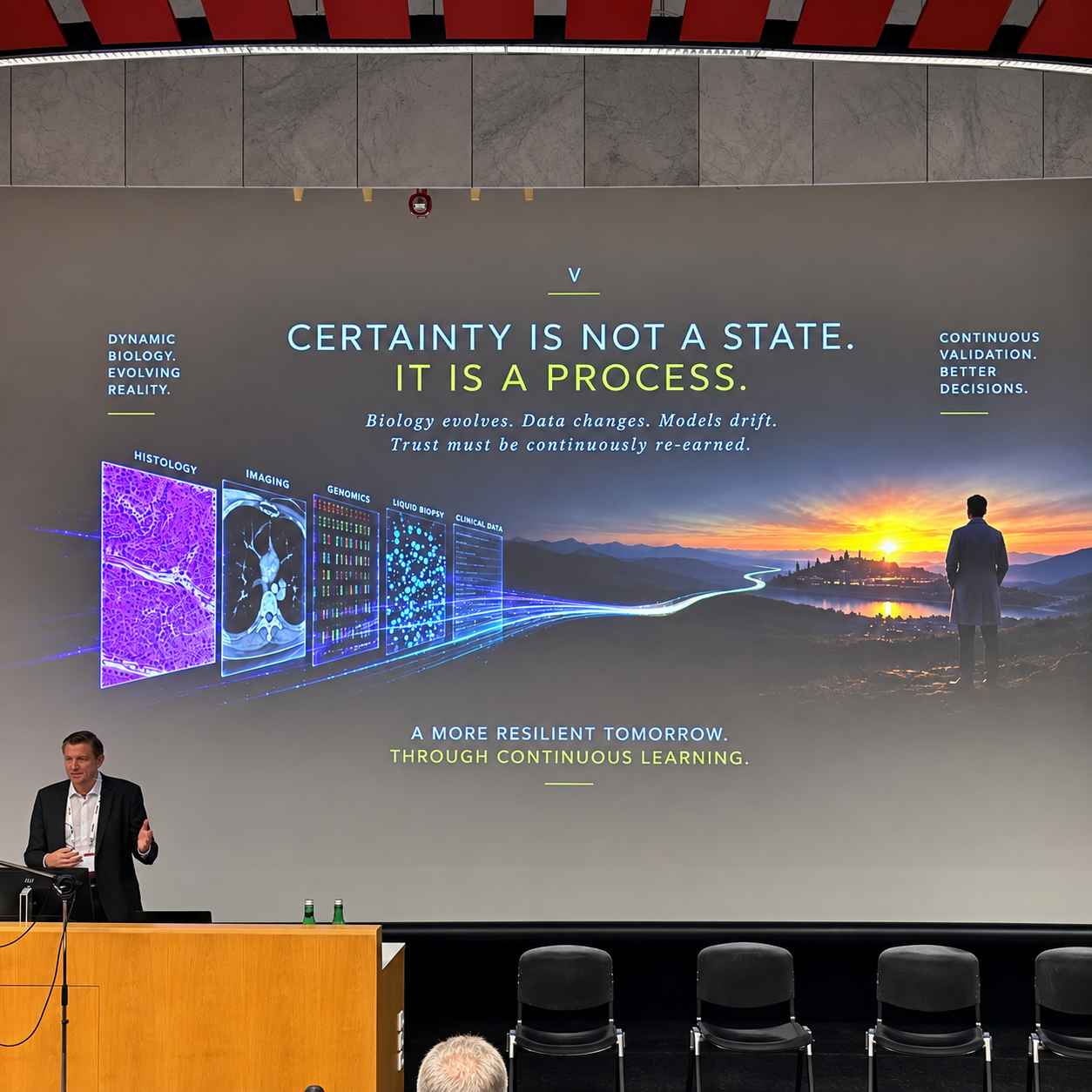
The slide that circulated most at D4 put another theme well: certainty is not a state but a process. That matters once Diagnostics moves from measurement toward inference. A conventional assay is validated before use and then held inside a quality system. Computational outputs add variables that keep moving — populations shift, source systems change, methods change, models drift, practice evolves. An inferred diagnostic result therefore carries its own chain of qualification, and that chain has to be maintained rather than certified once.
D4 approached this through mechanisms that are all recurring rather than one-time: independent measurement used as ground truth, external and multi-site validation, human oversight, monitoring of model behaviour, and keeping regulated clinical decision support separate from other AI functions. The common feature is that none of them is a gate you pass once. Each is an activity that has to keep running, which means trust carries an operating cost, not only a development cost.
The commercial reading of this is the important one. If new diagnostic information is produced computationally, trust in it has to be built, demonstrated and sustained over its life. Assurance stops being a hurdle on the way to market and becomes part of the capability being sold. A provider who can maintain trust in a computational output over time is offering something a data set alone never can.
The investment comes before the value
It is tempting to read the volume of existing diagnostic data plus the speed of AI as an easily accessible new value pool. D4 pointed to a more demanding picture, and the demand is where the opportunity is defined.
Dependable computational and integrated diagnostics need systems to gather and expose information, semantic and interoperability work, qualification and curation, clinical expertise, software development, validation, regulatory work where it applies, security and governance, workflow integration, and continuing operation and assurance. Some of that is capital; much of it is recurring operating cost. So the economic question is not what an algorithm can technically infer from a dataset. It is what it costs to build and sustain the whole system that turns that inference into trusted clinical value — and who is positioned to carry that cost and price it.
The technology is moving faster than the operating and commercial architecture around it. That gap is the opportunity. New value will come not only from computational diagnostic products, but from the refining layer itself: integration, curation, qualification, validation, evidence generation, lifecycle assurance and interpretation. Whoever operates that layer well sits closer to the value than whoever merely generates or stores the data.
Refining is not built alone
Very little of this can be built by one participant. Laboratories understand the analytical process and the diagnostic context behind the information. IVD companies bring assay, instrument, quality, regulatory and commercial capability. Health-IT providers hold much of the connectivity and information architecture. Hospitals understand local workflow and increasingly build their own informatics and AI. Professional bodies supply standards, expertise and the networks in which validation and collaboration happen.
That mix reshapes the relationship between industry and its customers. Several hospital presentations showed institutions building their own decision support and algorithms; as software development becomes more accessible, a sophisticated customer no longer has to wait for a vendor. So the strategic question for an IVD company is sharper than it used to be: where does industry add enough value that a laboratory or health system prefers to partner rather than build it in-house? Regulatory scale, cross-site validation, interoperable and supported products, evidence generation and deep diagnostic-domain knowledge are the plausible answers — but each has to be demonstrated in the solutions and partnerships that actually get built. The future relationship is less about developing technology for laboratories and more about building certain capabilities with them.
From owning the data to organising the learning
D4 suggested one more turn of the analogy, and it is the part I keep returning to. Gold is valuable partly because it is scarce and possession is exclusive. Diagnostic information is different: under sound governance, much of its value grows when observations are compared and learned from across larger populations and more institutions — better real-world performance, population differences, longitudinal behaviour, reference systems, post-market signals, external validity of models.
So the competitive asset may not be the largest isolated stockpile of data. It may be the ability to organise a trusted learning system around diagnostic information while holding quality, provenance, privacy, compliance and appropriate local control. That is a harder thing to build than a database, and a more defensible one to own.
The question I would put to the industry
If the refining layer is where value concentrates, then the strategic contest in Diagnostics over the next few years is about who builds and operates it — the IVD companies, the laboratories, the health-IT providers, or partnerships that none of them could form alone. For anyone leading a diagnostics business: are you positioning to sell tests into that world, or to own part of the layer that turns diagnostic information into trusted value? Those are different strategies, and they call for different investments now.
I would be interested to compare views with others working on this — particularly commercial and strategy leaders who are already having to make that allocation.
Conference Website: D42026 Website
Related Documents: Beyond the data feed – Diagnostic contribution in Health-Intelligence
5020 Salzburg, Austria