From “Hearing the Light” to Preventive Health Understanding
The 2026 Merck Future Insight Prize focused on a provocative proposition: future healthcare may depend increasingly on the ability to observe biological change before symptoms, deterioration or clinical crisis make it visible.
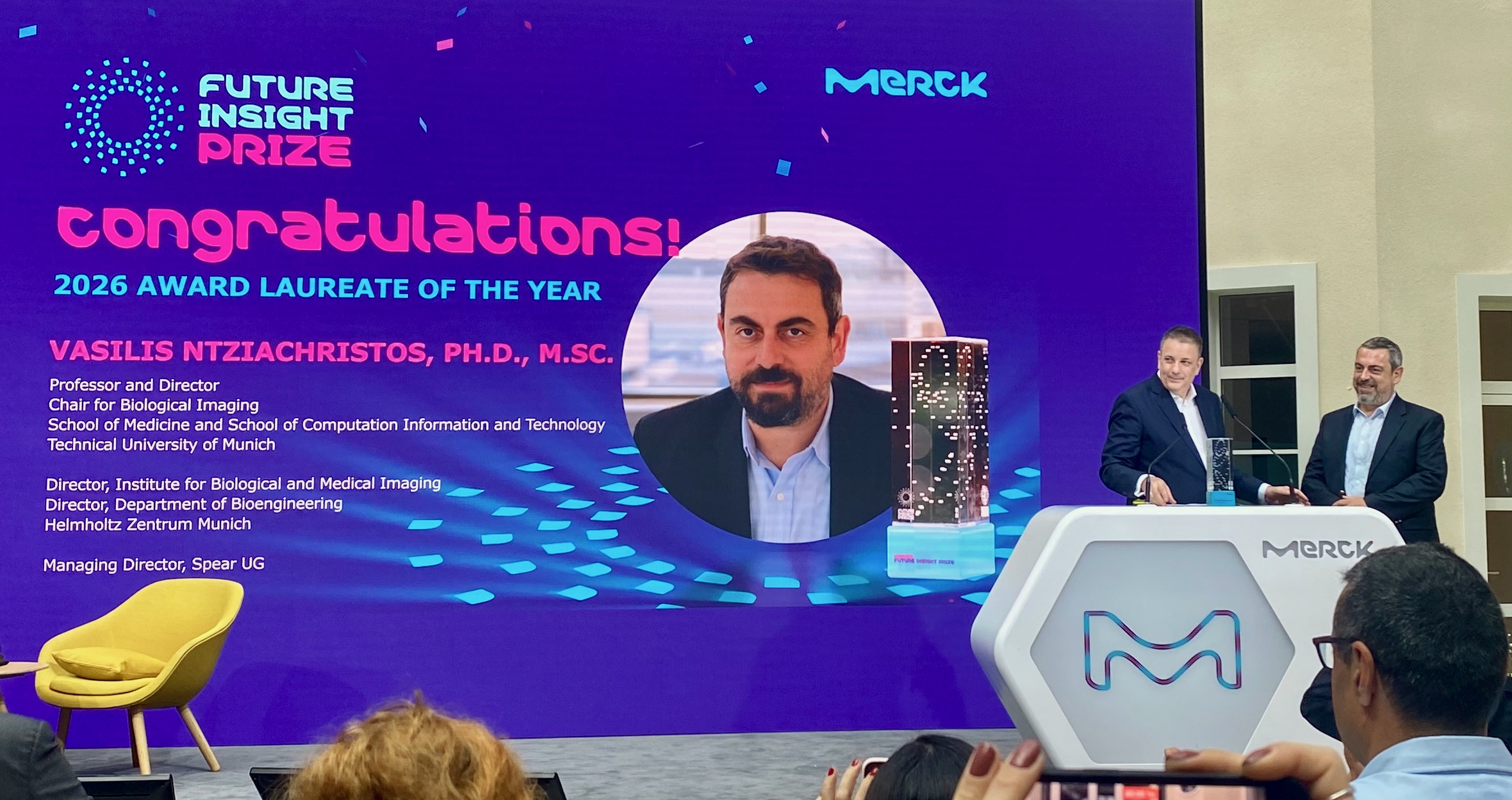
The prize was awarded to Professor Vasilis Ntziachristos for his pioneering work in optoacoustics, an approach he memorably described as “hearing the light.” The phrase captures a sophisticated technical idea with potentially important clinical implications. Light can reveal biologically relevant characteristics within tissue; optoacoustic methods convert those light-derived signals into ultrasound information that can be detected and reconstructed. The result is a non-invasive way of accessing features such as microvascular structure, oxygenation, metabolic activity and molecular composition.
The ambition is not simply to add another sensor to the growing catalogue of wearable technologies. It is to obtain richer biological information: information that could potentially contribute to the diagnosis and monitoring of selected diseases, particularly where changes in vascularity, oxygenation, metabolism or tissue composition matter clinically.
Event / Location / Date: Merck Future Insight Prize 2026 / Darmstadt, Germany / 23 June 2026
Why This Event Mattered
The Smart Health Sensor concept sits at the intersection of preventive medicine, advanced sensing, diagnostics, engineering and digital health. Its underlying promise is straightforward: move healthcare away from a model in which disease is investigated after symptoms emerge, towards one in which relevant biological changes can be observed continuously—or at least frequently enough to identify meaningful deviation earlier.
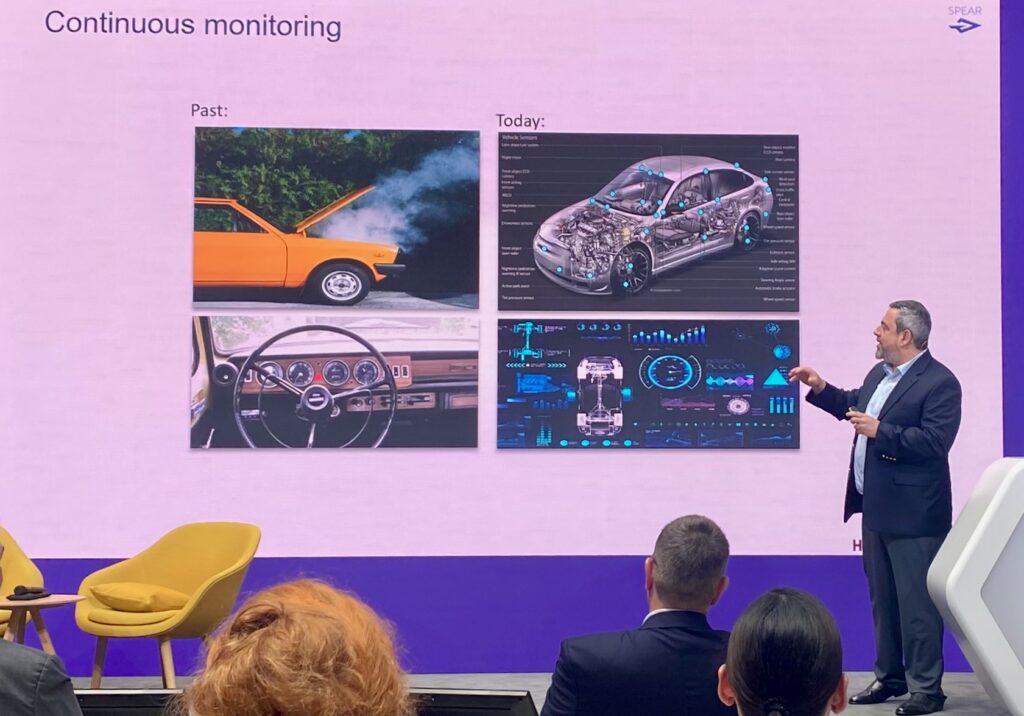
The familiar comparison presented during the event was between an older car and a modern sensor-rich vehicle. In the older model, the warning light often appears only when a problem has already become serious. In the newer model, multiple sensors may identify deterioration before failure occurs.
Healthcare still resembles the first model more often than the second. Patients develop symptoms, seek care, undergo testing and receive intervention after a problem has become clinically significant. The long-term preventive-health vision is to recognize relevant changes earlier, create opportunities for earlier intervention, and potentially delay or avoid severe disease progression.
This is not a claim that sensing alone will prevent disease. It is a recognition that prevention becomes more realistic when biology can be observed before clinical failure becomes obvious.
Field Observations
The most compelling aspect of Ntziachristos’s work was not only the scientific performance of optoacoustics, but its translational direction. The technology is being developed towards miniaturisation, practical usability and lower-cost formats that could eventually support more routine use beyond specialised imaging environments.
That path remains demanding. A high-performance scientific platform does not automatically become an affordable device for frequent, everyday or home-adjacent use. It requires engineering progress in miniaturisation, usability, reproducibility, manufacturability, validation and cost. But this is precisely what makes the work strategically interesting: the research agenda is not confined to better imaging. It reaches towards a new category of accessible biological sensing.
The distinction between continuous and frequent monitoring also matters. Not every health question requires permanent measurement. For many conditions, periodic or repeated monitoring may be more useful, clinically appropriate and economically realistic. The larger shift is from isolated measurements to a more longitudinal understanding of biological change.
That could be relevant for preventive medicine in several ways: recognizing deviation earlier, monitoring risk trajectories, supporting treatment follow-up, and helping distinguish temporary variation from meaningful change over time.
The potential sustainability contribution is equally important. Earlier recognition of deterioration may reduce avoidable acute episodes, late intervention and resource-intensive disease management. Yet the event did not treat this as automatic. Healthcare sustainability will depend on evidence that sensing improves outcomes, supports appropriate decisions, fits clinical workflows and creates value rather than simply generating more data.
Human Atmosphere and Professional Exchange
The panel discussion was notably high-level because it brought together participants who represented different but necessary layers of healthcare innovation. Rather than treating smart sensing as a purely technical problem, the discussion exposed the full chain from scientific discovery to patient benefit.
Vasilis Ntziachristos represented the sensing-science perspective. His contribution kept the discussion anchored in the quality and depth of biological information that future technologies may be able to access. The central point was clear: more data is not necessarily more insight. Preventive medicine requires meaningful information, not simply greater volumes of measurement.
Agnes Musiol brought the perspective of wearable-health entrepreneurship and continuous biochemical monitoring. Her contribution made the translation challenge concrete: technologies need to become usable, understandable and sufficiently valuable for people to adopt them in real life. The path from laboratory capability to a product that individuals can use repeatedly is not a secondary issue; it is part of the innovation itself.
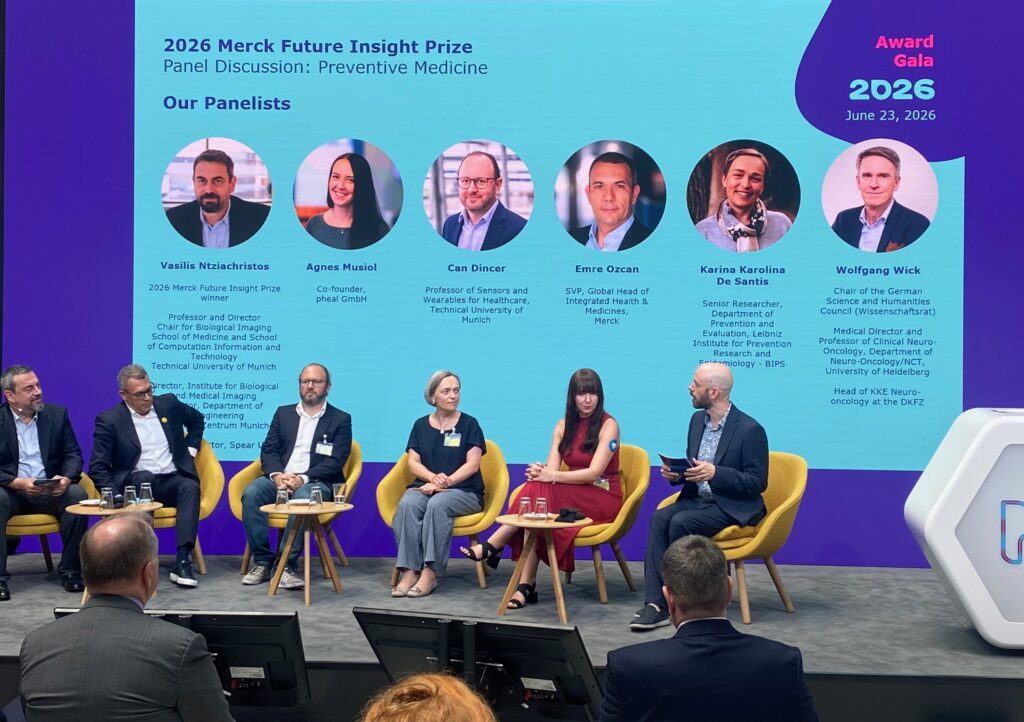
Can Dincer represented the engineering dimension. The discussion repeatedly returned to the practical challenge of turning advanced sensing science into robust, compact, reproducible and affordable systems. Miniaturisation is not merely a design exercise. It is one of the conditions that determines whether sophisticated sensing can move from specialised settings towards wider clinical or everyday use.
Emre Ozcan provided one of the strongest system-level perspectives. He shifted the conversation from technology to implementation: evidence generation, reimbursement, ecosystem development, digital-health integration and commercialisation. His contribution made clear that even highly promising sensing technology will not create healthcare value unless it can be absorbed by health systems, validated through credible evidence and connected to workable pathways of adoption.
Karina Karolina De Santis kept prevention and human behaviour at the centre of the discussion. Her perspective was essential because better monitoring does not automatically create better health. People need to understand, trust and act on the information they receive. Prevention depends not only on technology, but also on education, engagement, public-health design and realistic recognition of behavioural and social determinants.
Wolfgang Wick brought the clinical and science-policy perspective. His presence reinforced the need for clinical relevance, validation and professional accountability. A sensor can detect a biological signal; healthcare still has to determine what that signal means, when it matters and how it should influence care.
The value of the panel was precisely this combination. It did not reduce the future of preventive medicine to a single breakthrough. It showed that scientific discovery, engineering, patient behaviour, clinical practice, evidence, reimbursement and industrial translation will all shape whether the Smart Health Sensor becomes meaningful healthcare infrastructure or remains an impressive technical possibility.
Strategic Implications
The event’s deeper message was that healthcare may be moving from episodic diagnosis towards more continuous or frequent observation of human biology. Advanced sensing could make it possible to detect relevant biological change earlier and to support a more preventive, longitudinal approach to health.
For diagnostics, however, the decisive issue is not only whether more measurements can be made. It is whether the resulting information can remain clinically meaningful as it moves through digital systems, care pathways and patient-facing applications.
That requires a distinction between sensing and understanding. A signal becomes useful only when it can be interpreted in context, connected to the right clinical question, validated, communicated and translated into proportionate action.
The potential contribution to healthcare sustainability is substantial, but conditional. Earlier detection and better monitoring may help avoid avoidable deterioration and reduce the burden of late intervention. But this will depend on disciplined evidence, appropriate workflows, behavioural engagement and economic models that reward prevention rather than only treatment.
The prize therefore pointed beyond an individual technology. It raised a wider question for diagnostics, digital health and healthcare systems: can richer sensing be translated into earlier, more intelligent and more sustainable care without reducing biological meaning to another undifferentiated stream of data?
Related Persodia Material
Beyond Market Access: Foundations for Sustaining Europe’s IVD Leadership (Monograph, 2026)
Inside Clinical Diagnostics Industry – Constraints shaping Strategy – Towards Health Intelligence (Book, 2026)
Event Link
Merck Future Insight Prize 2026 programme and award announcement.