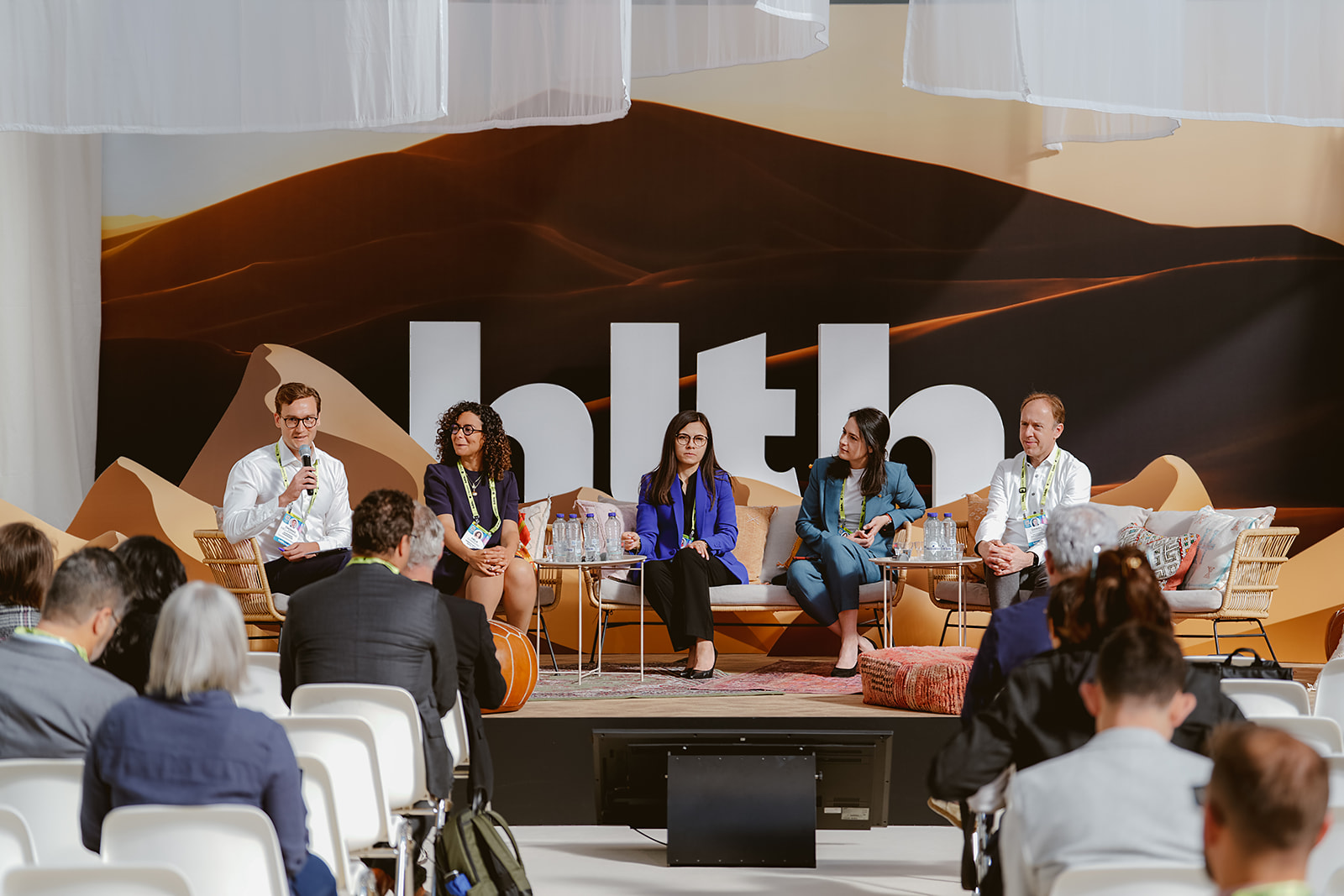
This Observation draws on HLTH Europe 2026 as a selective but useful view of where healthcare attention is moving. No conference represents the full reality of healthcare. Conferences highlight certain themes, attract particular audiences, and leave much of everyday clinical, operational, and institutional life outside the room. Even so, they can reveal where investment is flowing, which actors are entering the conversation, and which questions are beginning to shape the agenda.
Before the event, I asked whether diagnostics was at the table, on the table, or still mainly an upstream supplier of products, results and data. HLTH Europe did not provide a simple answer, but it did sharpen the question.

Context
HLTH Europe was one of those places.
The first observation is that the event itself is a signal. Healthcare has traditionally organized itself around professional societies, scientific congresses, medical specialties and industry meetings. HLTH feels different. Its format borrows heavily from the technology sector. Providers, policymakers, startups, investors, technology companies and healthcare industry participants share the same space and, at least for a few days, engage in a common conversation.
The result is not always comfortable. The event can feel highly commercial. Some of the most interesting discussions take place behind closed doors. For an expensive conference, the number of invitation-only sessions can be frustrating. Yet despite these limitations, HLTH succeeds in bringing together groups that do not always interact naturally. That alone gives it value.
This matters because healthcare is no longer being shaped only inside the traditional boundaries of medicine, science, reimbursement, regulation and industry. Those forces still matter deeply, but they now interact more visibly with technology platforms, investors, data companies, policymakers, public-health priorities and consumer expectations. HLTH made that interaction unusually visible.
The conference itself therefore became part of the observation. It provided a temporary environment in which healthcare could be viewed less as a collection of separate sectors and more as an emerging ecosystem attempting to solve shared problems.
What Is Worth Noting
The second observation concerns the mood.
I expected AI to be visible. I did not expect it to dominate the agenda to the extent that it did.
Artificial intelligence appeared almost everywhere. It was discussed in relation to clinical decision support, workflow automation, interoperability, imaging, prevention, patient engagement and operational efficiency. In some sessions AI was the explicit subject. In others, it appeared as an assumed component of whatever solution was being proposed.
What became interesting after a few days was not the technology itself, but the confidence with which many participants spoke about it. The dominant question was rarely whether AI should be used. More often, the discussion focused on how quickly it could be deployed, how it should be governed and how organizations should adapt.
That is a meaningful shift. AI was not being presented only as a future possibility or a specialized innovation area. It was increasingly treated as part of the operating environment into which healthcare organizations will need to move.
One recurring theme captured this shift particularly well. Several conversations returned to the reality that clinicians and patients are already using tools such as ChatGPT on their personal devices. Whether healthcare institutions are comfortable with this trend is becoming less relevant. The behaviour already exists. The challenge is how healthcare responds to it.
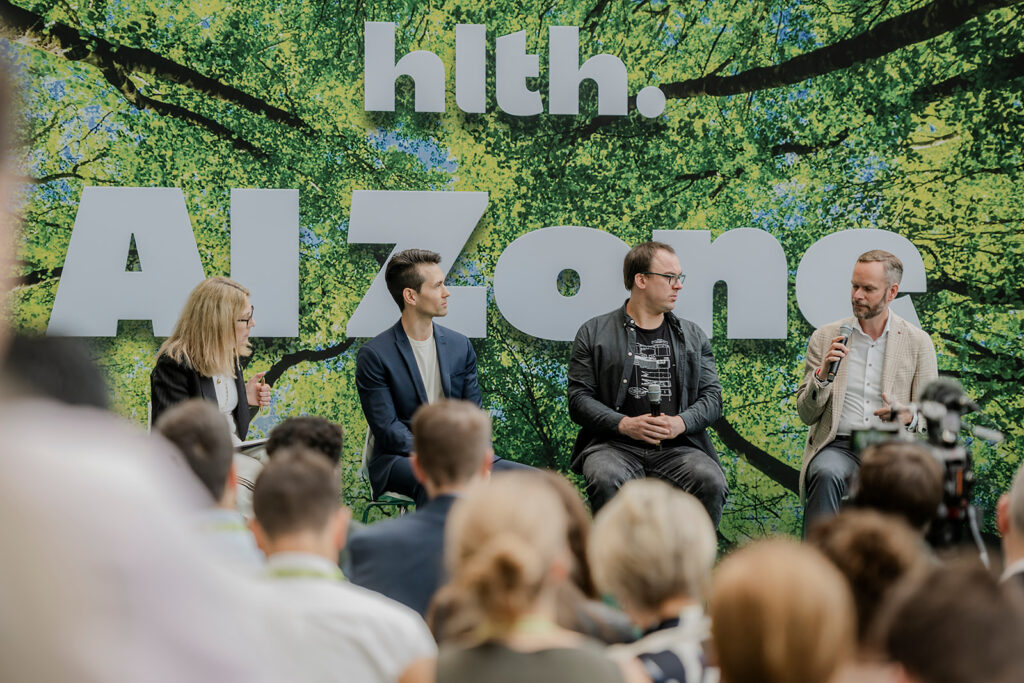
— Bart Scheerder, AI Strategy Lead, University Medical Center Groningen
This does not make governance less important. It makes governance more urgent. If informal use is already occurring, then institutions face a more difficult task than simply deciding whether to allow AI. They must determine how to create safe, useful, auditable and clinically responsible pathways for tools that people may already be using outside formal systems.
Beneath the AI discussion sat a deeper set of concerns. Financial sustainability, workforce shortages, growing demand, ageing populations and chronic disease were never far from the conversation. Prevention, longevity, obesity management, cardiovascular risk, genomics and population health all appeared repeatedly. Different speakers approached these themes from different directions, but many seemed to be responding to the same underlying pressures.
Viewed from this perspective, HLTH was not primarily a conference about technology. It was a conference about healthcare systems searching for practical responses to structural challenges.
That interpretation was reinforced repeatedly by healthcare leaders confronting workforce and capacity realities.
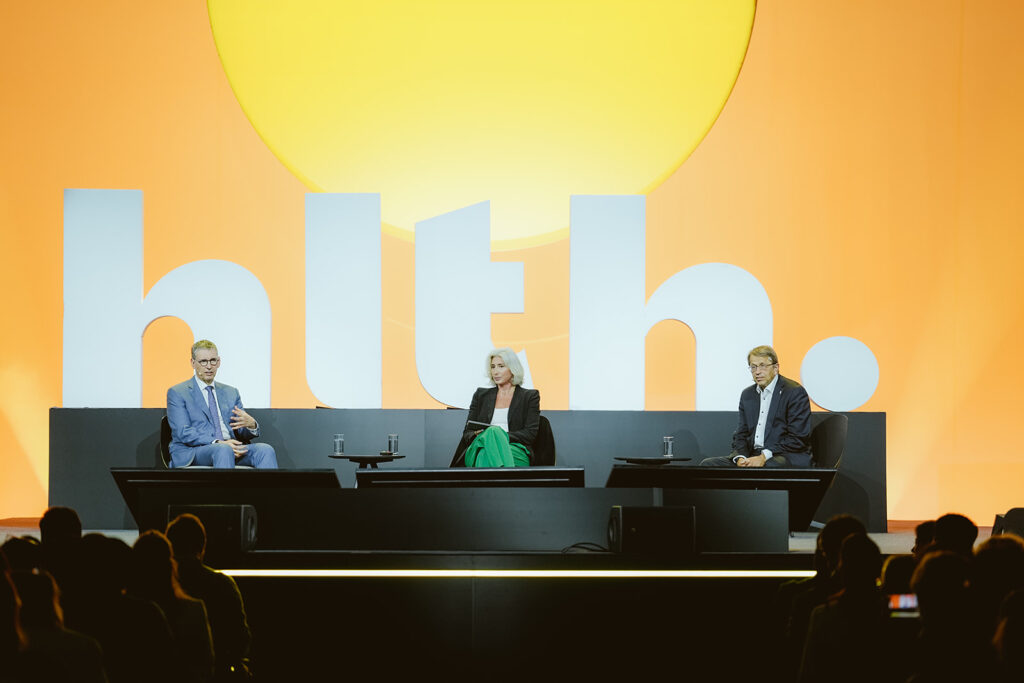
— Heyo K. Kroemer, CEO, Charité – Universitätsmedizin Berlin
At the same time, Europe was clearly wrestling with the governance implications of these developments. Discussions around the European Health Data Space, interoperability and AI regulation reflected a common concern: technology is advancing rapidly, while institutions are still determining how to govern it responsibly.
The resulting tension was visible throughout the event. Organizations want innovation, but they also want trust. They want access to data, but they also want accountability. They want faster adoption, but they also want safety and legitimacy.
By the final day, I found myself returning to a phrase already familiar from my own work: health intelligence. The term appears in Beyond Market Access: Foundations for Sustaining Europe’s IVD Leadership and forms part of its concluding discussion. At HLTH Europe, however, it felt less like a conceptual idea and more like an observable trend.
Not because speakers used the term consistently. Most did not. Rather, because many separate conversations appeared to be moving toward the same practical objective: improving how healthcare acquires information, combines information from different sources, interprets it and uses it to make decisions.
That is the direction of travel worth noting.
Why It May Matter
The implications for diagnostics are significant.
Diagnostics was not absent from HLTH Europe. Quite the opposite. Imaging, biomarkers, genomics, screening, monitoring and evidence generation appeared throughout the event. Yet diagnostics often seemed to occupy a particular role within the broader discussion. It was frequently presented as a source of information rather than as a discipline concerned with the creation of meaning.
The comparison with radiology remains important. HLTH.rad gave imaging a visible institutional platform around AI, workflow and implementation. Laboratory diagnostics appeared more implicitly, even when laboratory information was essential to the same broader discussion.
Radiology’s visibility may reflect the natural fit between imaging and current AI applications. It may also reflect a growing need for radiology to redefine its position within increasingly automated workflows. Whatever the reason, imaging occupied a prominent place in discussions about the future.
Laboratory diagnostics was present, but often more implicitly.
Diagnostic information appeared everywhere, but laboratory medicine itself appeared less often as an independent subject.
This is not a marginal detail. It suggests that diagnostics may become more important to healthcare decision-making while becoming less visible as a governing discipline.
That distinction may prove important. The future value of diagnostics may depend not only on producing information, but also on influencing how that information is interpreted and used. As healthcare becomes increasingly dependent on AI and data-driven decision-making, control over the utilization of diagnostic information may become as important as generating the information itself.
One discussion at Karolinska University Hospital captured this challenge particularly well.

The observation applies far beyond genomics or precision medicine. Healthcare is becoming increasingly capable of generating information. The harder challenge is determining which information matters, how it should be interpreted and how it should influence decisions.
No single company at HLTH appeared capable of addressing the entire challenge. Large technology firms presented ambitious visions. Healthcare companies promoted impressive solutions. Startups offered innovative approaches. Investors searched for scalable opportunities. Policymakers and providers brought system constraints back into view. Yet most organizations still seemed focused on solving individual pieces of a much larger puzzle.
That may actually be encouraging. Healthcare remains too complex for simple answers. The future is unlikely to be shaped by a single platform, company or technology. It will probably emerge through the interaction of many different actors operating across a highly fragmented system.
I left Amsterdam more optimistic than when I arrived. Not because the answers are clear. They are not. Not because the risks have disappeared. They have not.
Rather, because the quality of the discussion was higher than expected. The event brought together an unusually broad range of people, ideas and perspectives. The energy was real. The ambition was real. The willingness to experiment was real.
Whether all of this activity ultimately produces better healthcare remains to be seen. But the search is underway, and it is happening at a scale that is difficult to ignore.
For diagnostics leaders, that may be the most important takeaway. The future discussion is no longer only about better tests, better instruments or better analytical performance. It is increasingly about how diagnostic information will be incorporated into emerging systems of decision-making.
Healthcare, as seen at HLTH Europe 2026, appears to be moving in that direction.
The strongest post-event impression is that diagnostics is not absent from the emerging healthcare architecture. It is present as product supplier, infrastructure provider and evidence input. It is less clearly present as a participant in system design.
Understanding whether diagnostics can shape those systems, or merely supply information into them, may become a central strategic question for the industry.