Every analytical technology that enters clinical diagnostics begins in a different market, with different rules, different capital requirements, and different criteria for what constitutes a functioning product. The distance between those two markets is not always visible from the analytical side. It tends to become visible only after commitment has been made.
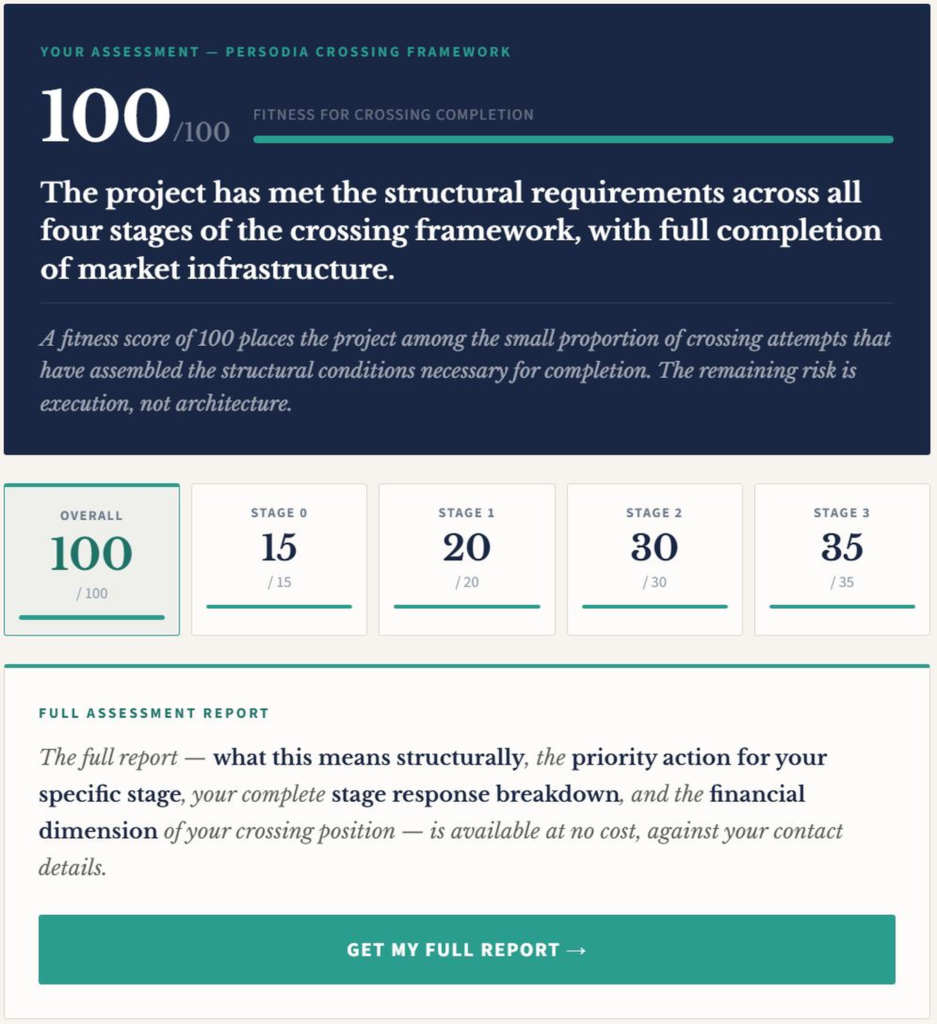
The Crossing Assessment Tool applies the monograph framework to a specific product and makes that transition legible. It does not model the full path of the crossing. It provides a simplified view of where a product currently stands relative to the conditions required for sustained clinical deployment.
The gap is structural, not technological
The gap between analytical performance and clinical deployment is rarely a performance gap. Technologies that fail the crossing are often technically superior to those that succeeded before them. What they lack is alignment with the structural conditions that clinical markets impose before they will accept a new technology at all.
Those conditions are not arbitrary. They reflect the accumulated requirements of operating diagnostic systems at scale, in regulated environments, with legal accountability for every result. They do not relax for strong performance. They apply uniformly, regardless of what a technology can do in a laboratory.
The tool does not measure performance. It evaluates whether those structural conditions are assembled.
What a complete crossing requires
A complete crossing is not defined by speed or cost. It is defined by structural completeness — a state in which every condition required for sustained clinical deployment is in place before full commitment is made.
These conditions include:
- a complete and industrialised system
- clinical evidence demonstrating impact on patient management
- defined clinical use within care pathways
- regulatory authorisation
- viable test payment mechanisms
- compliant supply and service infrastructure
- access to customers and deployment capability
- financing that can sustain the full duration of the crossing
None of these conditions is sufficient on its own. A product that meets most but not all will fail in the same place as one that meets none: it does not reach sustained clinical use.
What the tool produces
The tool provides a structured assessment of a product’s position relative to these conditions.
It identifies:
- which conditions are in place today
- which are planned and funded
- which are absent, undefined, or unfunded
The output combines:
- a completion score, reflecting the degree to which the full set of conditions is assembled
- a stage-based breakdown, showing where gaps remain
- a capital constraint, indicating whether the crossing can be sustained through its full duration
The score represents degree of completion, not readiness. Routine clinical deployment requires all conditions to be in place.
The tool does not model sequencing or interactions between conditions. It provides a simplified, static view of completeness at a given point in time.
Possible readings
The assessment may show:
- that the crossing is close to completion and structurally viable
- that it is progressing but remains incomplete under current conditions
- that key elements are absent and the crossing cannot be sustained
It may also indicate that remaining in the analytical market is strategically preferable, where structural conditions for diagnostics would erode rather than extend competitive advantage.
The tool does not prescribe a decision. It makes the structure visible.
Relation to the monograph series
The Crossing Assessment Tool is the applied instrument of Crossing from Analytical to Diagnostics: The Difficulty is the Moat (Persodia Research, Monograph No. 1, March 2026), which establishes the structural argument the tool operationalises.
Both draw on the framework developed in Inside the Clinical Diagnostics Industry: Constraints Shaping Strategy — Towards Health Intelligence (Oliveira, 2026).
Access
The Crossing Assessment Tool and its applications are available without charge. The material may be read, cited, and discussed freely. It may not be reproduced or repurposed without prior written permission.
http://www.persodia.org/tools/crossing-tool/crossing_assessment_tool_v11.html